

Your company probably has a wellness program. Maybe it’s a meditation app subscription, a mental health awareness day in October, or a motivational poster in the kitchen that says “You’ve Got This.” And yet the people around you are burning out, quietly disengaging, or getting sick in ways that don’t show up on any spreadsheet until someone doesn’t come back.
Workplace burnout has become the defining professional crisis of our era. The UK’s 2025 Workplace Burnout Report found that 91% of workers experience extreme stress every year. Nearly half of HR professionals named workplace burnout their biggest challenge going into 2026. The cost to the National Health Service alone is between 17 and 26 billion pounds annually. These are not fringe statistics. They are the result of something that has been building for a long time within organizations that meant well but fundamentally got it wrong.
Jody Brooks has a name for what went wrong. He calls it wellness washing.
What Is Wellness Washing?
Wellness washing is the corporate habit of performing wellbeing without changing the structural conditions that actually cause workplace burnout. It’s the organizational equivalent of washing your car and hoping that fixes the engine.
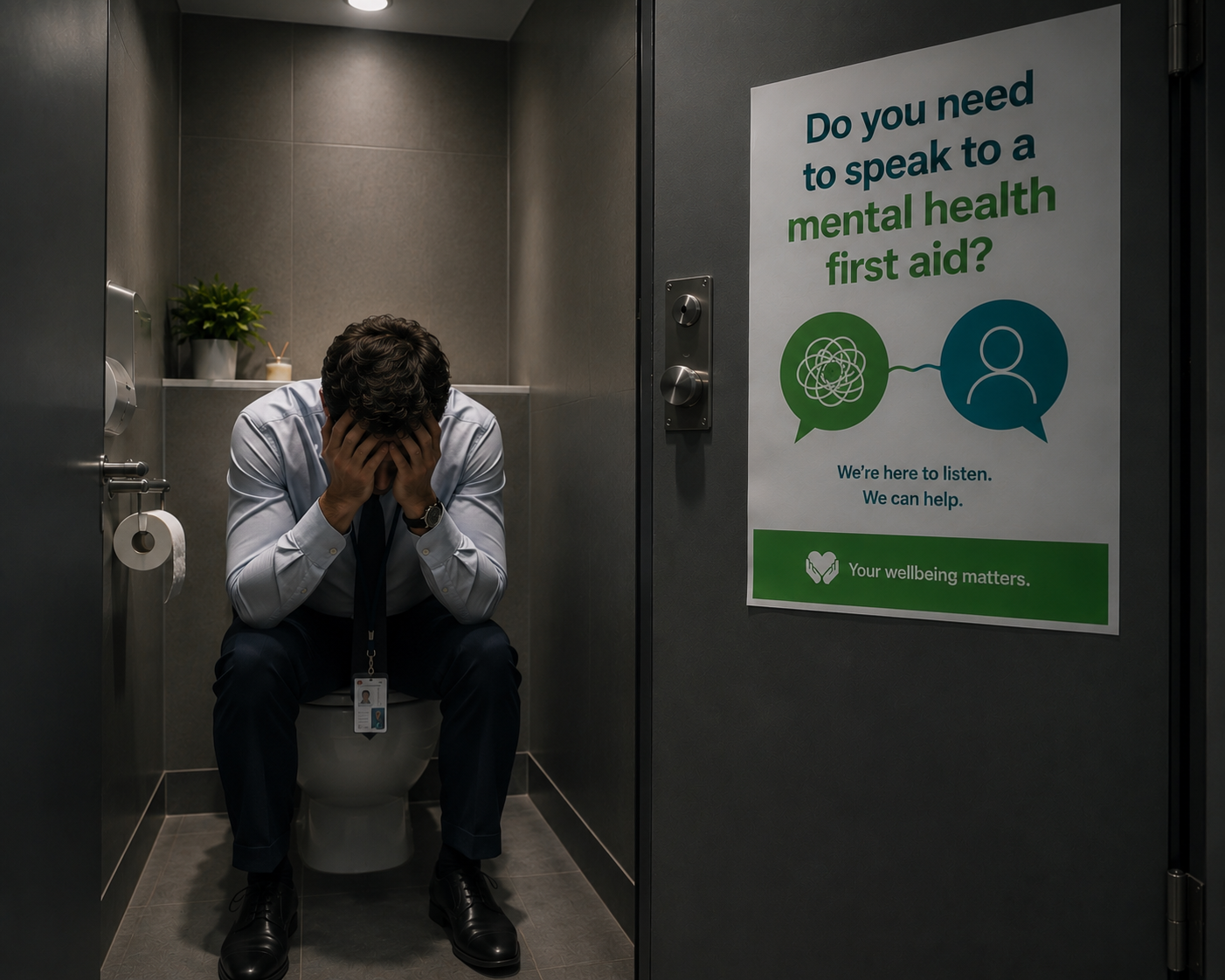
Jody Brooks is a workplace burnout and midlife coach, former senior leader in international education, award-winning entrepreneur, and UN speaker on business sustainability. He knows the pattern from both sides. He lived it: years of external success, an erosion on the inside, and a moment of reckoning in a toilet cubicle at a corporate head office, staring at a poster asking whether he needed to speak to a mental health first aider.
“Two things happened in that moment,” he told me on the ProductiviTree Podcast. “First, I acknowledged how bad I felt. Then I thought: no, I’m never talking to anyone in this building, because you did this to me.”
That realization became the foundation of his work. The poster was wellness washing in its purest form: a visible gesture toward care that changed nothing about the environment producing the crisis.
Why Wellness Perks Often Make Things Worse
The problem with most corporate wellness initiatives is not that the tools are bad. Meditation apps are not inherently useless. Yoga classes are not harmful. The problem is the intent behind them and what they leave untouched.
Research from several North American universities found that uptake of corporate fitness perks typically comes from people who already exercise regularly. They are getting a free yoga class, not becoming healthier. Meanwhile, employees who don’t exercise often feel more alienated: the message they receive is that their well-being is a personal failure, and the solution is to do something they already feel excluded from.
What this does, Jody argues, is place the problem on the individual. The implicit message from a lunchtime yoga class is: you are stressed because you are not managing yourself well enough. Fix yourself, and the workplace will be fine. But the workplace is what broke in the first place.
“We’re running businesses like it’s 1900,” he said. “The system hasn’t updated itself for over 100 years.”
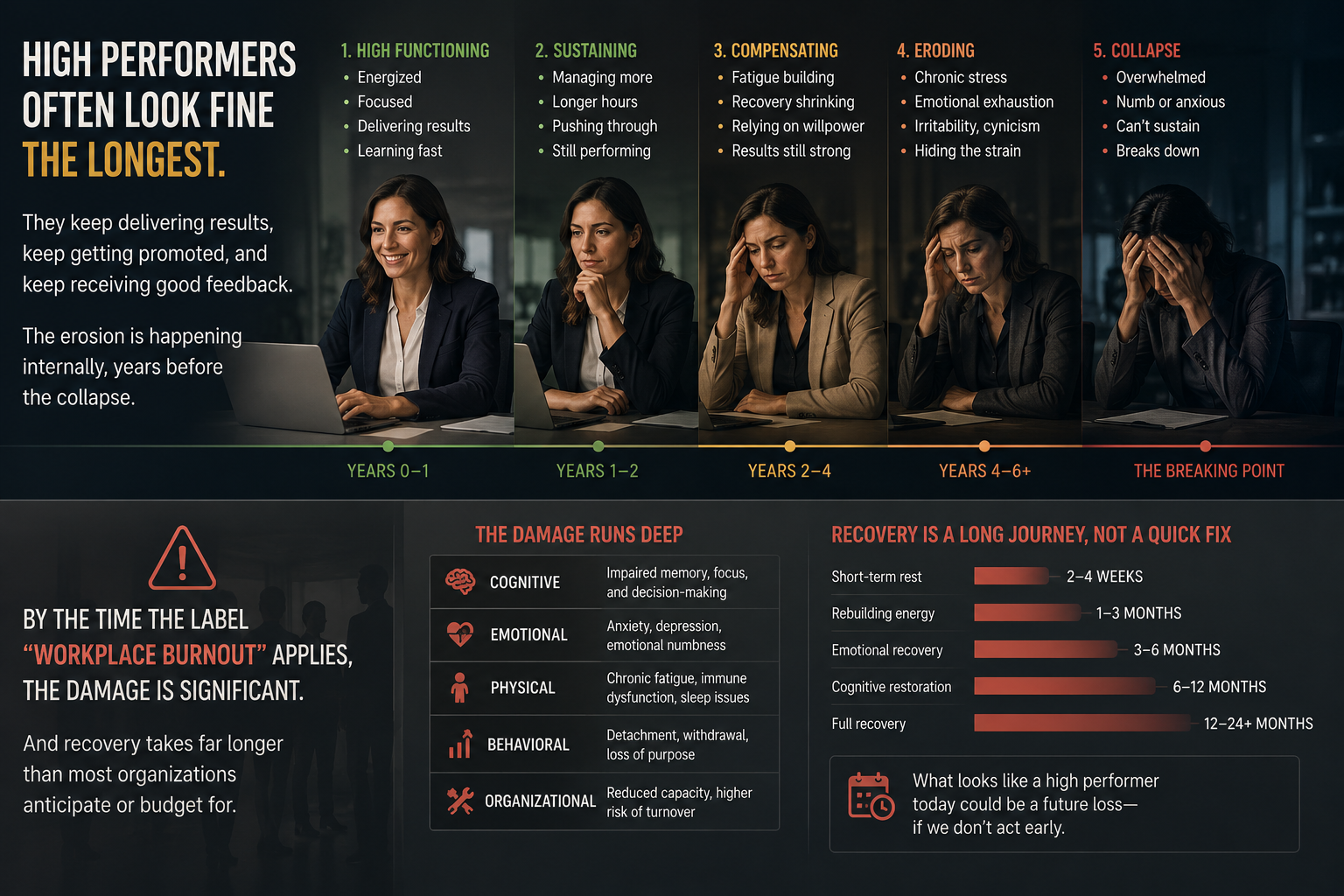
This matters for how we think about high performer workplace burnout specifically. High performers often look fine the longest. They keep delivering results, keep getting promoted, and keep receiving good feedback. The erosion is happening internally, years before the collapse. By the time the label “workplace burnout” applies, the damage is significant, and recovery takes far longer than most organizations anticipate or budget for.
The Structural Condition Most Companies Fail to Protect
If you ask Jody what single structural condition organizations consistently fail to protect, the answer is not workload management or flexible hours. It’s the absence of genuine psychological safety, though he’d push back on that phrase too.
“Bring it back a bit,” he said. “Let’s have a conversation about emotional well-being and stop using scary words or buzzwords that nobody understands. If your focus in the first place was on creating a place of wellbeing, you would never need to ask yourself, are people psychologically safe?”
The more honest answer is this: organizations consistently fail to protect the basic human need to be seen, heard, listened to, and to belong. When those four things are absent, no amount of app subscriptions or resilience training closes the gap. They might even widen it by signaling that the organization sees the problem but refuses to address its source.
HR departments are often caught in the middle. Jody is clear that he is not down on HR. But he is honest about their position. They are there, in practice, to keep the company legally protected, not to be the guardian of employee wellbeing. When shareholder expectations drive everything upstream, HR’s capacity to effect structural change is constrained before it even starts. “There is nobody now who is really the guardian of the employees,” he said. “When push comes to shove, HR has to take the company line.”
The Nine Principles of Authentic Living
After his own collapse and recovery, Jody built a framework he calls the Nine Principles of Authentic Living. They are not a checklist. They are a sequence, and the sequence matters.
The first is Awareness. Not a generic mindfulness practice, but a deliberate pause from the performance, the act of stopping long enough to notice what is actually happening inside. Jody’s own awareness began in that toilet cubicle. For the two weeks that followed, he journaled every day for the first time in his life. The patterns became visible.
Understanding follows. Once you can see what’s happening, you can begin to understand why. For Jody, this meant getting clear on his five core values and recognizing how far out of alignment he had drifted. One of his core values was integrity. His role was asking him to act without it. The exhaustion suddenly had a name.
Trust comes third: learning to trust the inner voice and manage self-doubt rather than be governed by it. Then Honesty, not just honesty with others, but the specific, uncomfortable honesty we owe ourselves. Jody’s example: he was a vegan who believed his body was a temple. Honesty meant acknowledging he was eating enough for the whole congregation.
Empowerment is the moment of the blank page. You have stopped, understood, trusted, and been honest. Now you realize you get to write what comes next. Nurture follows: real change in small, consistent steps, linked to identity rather than willpower. Jody lost significant weight not by deciding he needed to lose weight (which the subconscious hears as a vote against the self) but by repeating each morning: “I am someone who honors my body, my health, and my wellbeing.”
The final three principles, Transformation, Integrity, and Compassion, are what Jody calls the protect phase. Transformation is understanding that being broken is part of the process. He uses the Japanese art of Kintsugi: a broken ceramic pot repaired with gold. Nothing is discarded. The cracks become the most beautiful part. Integrity is the capacity to stand in your truth without deviation, even when others are uncomfortable with your change. And Compassion, the final principle, is self-forgiveness. Jody wrote himself a four-page letter of forgiveness, posted it to himself, waited for it to arrive, read it on a beach, tore it into pieces, and let it go.
This is the individual path out of workplace burnout. It connects directly to what I call the Ownership vector of the 4 Productivity Vectors: the capacity to take authorship of your own energy, focus, and direction, even when the environment around you is not helping. Ownership is not a denial of the structural problem. It is the refusal to wait for someone else to solve it before you act.
What to Do When You Cannot Fix the System
Most people listening to this work are inside organizations that they do not control. They cannot change their manager, cannot fix the culture, and are being told to build resilience while the conditions producing the breakdown remain exactly as they were.
Jody’s honest answer: You still have ownership, and you have to claim it. “If you say you have no ownership, then you have no ownership.” That is not victim-blaming. It’s a recognition that giving up ownership entirely means you will carry the same pattern into the next organization.
He accepts part of the responsibility for his own breakdown. He drove 40,000 miles a year. He worked 18-hour days. Nobody told him to. The organization contributed to the conditions, but he also made choices that extended the damage. Seeing both things clearly, structural failure and personal agency, is what allowed him to rebuild differently.
The practical test: when the environment you’re in pulls you so far out of alignment that your values are being consistently violated, a decision needs to be made. Stay and advocate for change with your full voice, or find somewhere that doesn’t ask you to betray yourself. But always with ownership. Always with the awareness you built in principle one.
If you want to understand where you are right now in terms of energy, focus, and direction, the free ProductiviTree Productivity Assessment is a good starting point. It won’t tell you whether your company is wellness-washing. But it will give you a clear picture of where your own performance is actually coming from.
The Kintsugi Lesson Nobody Teaches in Leadership Programs
What Jody brings that most corporate wellbeing conversations miss is the permission to have been broken. Not as a failure. As a prerequisite.
The organizations that treat workplace burnout as a personal weakness, and there are many, accelerate the crisis. Preventing workplace burnout quietly is the one producing the 91% statistic. The ones that could actually change, the ones writing A New Philosophy for the Workplace, which is the title of the book Jody is currently researching, are the ones willing to look at the system, not just the symptom.
Profitability and people are not in opposition. Companies whose employees feel seen, heard, and listened to, and who belong, perform better. The data on this is not new. What is missing is the willingness to wait for structural change to show up on a balance sheet, rather than expecting an app to generate a reportable metric by quarter-end.
Wellness washing gives organizations something to point to. Actual well-being requires something harder: the courage to ask what broke the people in the first place, and to change it.
You can find Jody Brooks at authenticcoaching.me. He offers a free 30-minute Authentic Clarity Call for individuals and organizations who want to work out where the pressure is coming from and what to do about it. His podcast, Messy Midlife, is on all major platforms.

Episode Transcript
Santi Tacoronte (00:01.346)
Jody Brooks, welcome to Productivity.
Jody Brooks (00:04.516)
Well, thank you for having me. I’m super excited for the conversation we’re gonna have today all around wellbeing and the workplace.
Santi Tacoronte (00:12.622)
So, my Jodi, you had a career, a long career in international education. You ran an award winning business. You spoke at the UN on sustainability in the United Nations. And by any conventional measure, this is a success story. But what was happening underneath?
Jody Brooks (00:35.842)
I think, you know, and obviously now I’ve transitioned and work as a coach in exactly that field, because like many people, I was externally successful. If you looked from the outside, I had everything I should want, but slowly on the inside, I was breaking. was empty. I felt disconnected and I lost the joy in going to work and I’d been blessed my entire career.
My grandmother always said, if you find something you love, you’ll never do a day’s work. And for the last 10 years, I started to feel like I was doing a day’s work. And the moment I joined the corporate, every day felt like a day’s work and the joy had gone. And eventually it broke me. It broke me emotionally and physically.
Santi Tacoronte (01:26.222)
How did it break you?
Jody Brooks (01:28.348)
moment of realization was sitting in a toilet cubicle, in the head office, crying with my head in my hands. not a particularly bad day, but I’d just reached that point of emotional and physical exhaustion. I looked up and on the back of the toilet cubicle door was a poster that said, do you need to speak to a mental health first aida? And.
I just remember it being this really sobering moment. There were two things that happened in that moment. The first was I acknowledged how bad I felt. I was like, it’s actually that bad that I probably should. The second one was, no, I’m never going to talk to anybody in this building because you did this to me. And that’s where my journey kind of started in really unveiling the
workplace wellbeing and wellbeing washing needs to actually be something that’s at the core of what people do. And so that moment of being broken propelled me to the work that I do now.
Santi Tacoronte (02:42.157)
Judy, a couple of months ago, a colleague of mine, we sat together to have a coffee and, you know, I’m talking about the high performer, someone that is in all the lists to be a successor for everything, promotion lists, everything. And he said to me something like, Santi, I don’t know how long I’m gonna last. I’m like, what do you mean? What do you mean? like…
I’m so tired. He didn’t use words like burnout or these kind of things. But what was the trigger for you, Jody? When did you finally realize, obviously the crying in the cubicle was the final act. But what happened before and after that that you say, can’t carry anymore?
Jody Brooks (03:31.397)
I it happens as a very, that’s the problem. And I don’t think you do use the word burnout until you’re sat in front of your doctor and they tell you that that’s what’s happened. You know, even at that point, you actually think you’re broken. There’s something wrong with you and you can’t cope. And it’s a very slow erosion. And it’s fed by the external pressures of trying outwardly to meet all of these expectations.
And your friend that you described there, that’s classic. You know, I worked in the top of my field and the higher up you are, the harder it is to come back because you have been driven into this world of next promotion, next big sale, next huge contract, next award-winning thing. And it physically takes its toll on you after a time. That physically takes its toll in terms of exhaustion. But emotionally what’s happening in all of that
is you’re becoming emotionally tired as well and your brain gets exhausted and what your friend described there is really, really true is, you you get to a point where you have decision fatigue. What would have been a simple decision now becomes the most complicated thing. And so this external performance that we’re always trying to achieve slowly erodes it over a period of time.
because we live in a performance and output driven place and striving for that is how you get there because your body will only take so much and so it’s a very slow erosion of constantly chasing an environment that is performative and output related.
Santi Tacoronte (05:15.501)
Wellness washing. I know this topic is very close to your heart and you’re very passionate about it. First of all, first things first, let’s explain to the audience what wellness washing is.
Jody Brooks (05:33.447)
So wellness washing is, you we’ve seen it in lots of things and essentially we have marketeers to thank for all of these things and it’s made itself into employment now. But we had green washing, which is where we called it something vegan and automatically the whole world believed that that was a better product for the planet. Companies clambered to be seen to be doing these things. And so the same again is this is where we
put up a shiny poster or we have an empty value or like eyewitness there, we put up a poster that says, speak to a mental health first aider. That’s wellness washing right there. What it’s doing is it’s changing what you see, but not the problem. And it’s looking like it’s acting and people are doing it not because they want places of wellness and wellbeing, but they want to be seen
like they are companies that care about wellness. And so, you know, if you like, if we compare it to a car, it literally is washing the outside without going under the bonnet, doing a full service and seeing what’s really wrong. It’s like washing the car and hoping that that fixes the engine.
Santi Tacoronte (06:54.327)
Do you have a specific example of wellness washing in an organization, something that is perhaps common?
Jody Brooks (07:01.922)
Yeah, think a lot of them is, know, particularly now, Mental Health First Aid is certainly one of them that I think is a huge driving factor, particularly here in the UK. I think they’re an amazing organisation. They do a lot, but it’s being used to wash rather than to change the workplace. Other things are the huge surge in apps now where companies really, you can tell by that whole function is again, the apps are great.
if the intention behind them is correct. But as a company, if you’re just sitting there in a HR department and going, we need to do something that makes us look like we’re doing okay, okay, let’s pay for this app and give everybody access to this app. And then nobody uses it because it’s not core to the beliefs or the philosophy of the company. And there is no engagement. Things like, you know, yoga classes at lunchtime. I’ve even seen that in an organization.
Santi Tacoronte (07:45.229)
.
Jody Brooks (08:00.218)
And so now you’re expected to get up from your desk and go and do yoga at lunchtime because it will make you feel better about your job. That is wellness washing. It’s not changing the system that’s broken and it’s not really embedding the wellbeing of your staff because what it tends to do is isolate people further. What you’re saying to the employees is you are the problem, you need to do this and then this place will be healthier. And actually,
That’s not the truth. The reason that people are suffering in the workplace is we still operate a system that hasn’t updated itself properly for probably over 100 years. We’re running businesses like it’s 1900 and it’s 2026.
Santi Tacoronte (08:47.149)
What about the people that actually go to the yoga classes? Are they somewhat ignoring the rest of signals that are going on in the organization and they say, well, screw it, I’m going to take the yoga class. What’s going on? Because some people seem to engage.
Jody Brooks (09:04.088)
Yep, so the statistics are out on it and I don’t have them exactly to hand but I’m more than happy to send them over. There was a huge piece of research done by several universities in North America and it concluded that in fact the uptake on those physical fitness things is usually from people who already do that. So it’s people now who are getting a free yoga class rather than paying for it. It’s not people becoming fitter and healthier that never went to yoga.
So again, this is that wellness washing and looking like it. What it also does is it polarizes the work team. And it says that actually, you this is the problem that I really dislike about wellness washing is when it all comes down to physical fitness. And it is based on all of those things because again, what happens is you get the fit healthy people engaging with it, but you get the ones
that feel that they’re not fit, they’re not healthy, that don’t exercise, feeling like they matter less. so, wellbeing is a much bigger subject than wellness. And organisations need to start focusing on wellbeing, which is the act of being, not doing, is the act of being well. And that encompasses our social, our psychological, and our physical workspace.
Santi Tacoronte (10:34.685)
Jodi, I’m a believer. I believe that people is good by nature. I believe in good hearts. And I do believe 100 % that most of these HR people mean good. But they’re getting it wrong. Why? And why do they… Why do companies…
tend to result on this set of actions that you said, wellness washing, and what should they do differently?
Jody Brooks (11:12.098)
I often sound like, and I usually prefix everything I say with, I am not down on HR departments. Please don’t think that. I think you have a very tough job, but I think HR has got lost along its way and it almost is in the name. Human resource. Okay. Not well, not departments of employee wellbeing, not departments of that.
human resource, you are managing a resource. And so the philosophy and there needs to be a shift change within that, you know, and it’s changed over time. We’ve gone from personnel, which was very administrative, you know, that was tick boxes. had personnel officers and then we went to human resources, but we need to move and shift again. And we need to understand that we can’t put people on a spreadsheet.
And that’s where it comes from is human resources have a really challenging job because again, it’s this performative world that we live in and these output metrics. So again, if you look at wellness, that’s why they like the apps because then someone can tell them that 30 employees engaged and then that’s great and we’ve ticked the box, but they’re not really measuring is our workforce wellbeing better? Are our employees engaging more?
Are we getting the best from the people that work from us? Or are they just being performative because we’ve created a culture in which it is literally about input output?
Santi Tacoronte (12:54.541)
Speaking about performative, which I fully, fully agree with you, do you think that HR today, I want to stay a little bit with our friends from HR. I have a lot of friends in HR. I love them. But I don’t think they’re empowered. I think that they are becoming, not because of themselves, because again, intentions are there, they are becoming more transactional than ever. KPI based, you said it.
Jody Brooks (13:04.924)
Okay, cool.
Jody Brooks (13:19.985)
Mm-hmm.
Santi Tacoronte (13:25.417)
Do you think that they are empowered to do more? Or do you think that they are somewhat doomed because the short-termism of the shareholder economies or the business these days is forcing them to just be administrative people?
Jody Brooks (13:45.243)
feel that they basically have become the gatekeepers of the company and that’s not the intention and it’s really sad. And, you know, they are there in a legislative format. They’re there to make sure the company doesn’t get sued. They’re there to make sure they’ve met their legal requirements. And then as a part of that, they kind of add on, it would be really nice if we looked after people at the same time.
You know, that’s not the priority, you know, the last company I worked for, like, I always thought it was, we had people in HR who were called talent acquisition officers. And I just thought, how unpersonal is that? Like I’m going to acquire some talent for the business. And, you know, and it just summarizes that
People are being treated like they are an expendable resource. Bring them in, use them up, get someone else to come in and do the job afterwards. And I don’t believe it’s the HR department’s fault. I believe it’s the people that sit in the boardrooms, the shareholders that continue to drive the fact that all they want is bigger profits. And everybody’s answering in that performative thing. Back to your question, where you said, like, why do we do that? Because we’re all doing that.
So HR is being performative to the director or to the board. The board is being performative to the shareholders and the trustees and everybody’s trying to get everything on a balance sheet and prove that they’ve increased the turnover. And as long as that happens, people are happy. And there is nobody now that really is guardian of the employees.
There is nobody really, when push comes to shove, the HR department has to take the company line, not the employee line. And so they’re doomed. They are not empowered because, you know, essentially the people they’re supposed to look after, they can’t, you know, a HR officer can’t sit there and say, actually, I think the company’s wrong.
Santi Tacoronte (16:03.947)
That’s quite gloomy, Jodi, because what you’re saying basically is, well, the board doesn’t care about people. So the HR departments will do as much as they can, but they will be always hand-tied. What do you think is going to make boards and shareholders change the mind and still care for profits? Because they’re there for profit, let’s face it. Bad.
care a bit more about people because I feel that we are at the rock bottom of people. It’s funny because all companies have to say, our biggest asset, our biggest, biggest asset is our people. It seems they don’t give a damn about them. What’s this?
Jody Brooks (16:53.614)
empty words, empty words. And I think that it is that, you know, I’m currently writing a book which is called A New Philosophy for the Workplace. And it’s called literally that because we need a new philosophy for our workplaces. We need to start at the top and understand that you will be more profitable, but you’re gonna have to understand that you have to do it in a different way. Because people who are fit, healthy,
Santi Tacoronte (17:02.925)
Mm-hmm.
Jody Brooks (17:23.482)
well, commit, believe in a company and will give so much more and also perform at their best in those hours. But you have to be brave and understand that that means an entire shift in your organization. That means an entire shift and you have to wait for that performance to come through. It doesn’t happen overnight. It’s not a metric that suddenly shifts. But lots of things that
it costs a company are hidden on a balance sheet. Day sickness.
Time off, people not actually, know, everybody does it. You know, when you lose heart in your company, you start putting in meetings on a Friday that you’re not going to. Now the company thinks that everybody’s working, but I promise you that in every organization and in the ones that are the worst, people start to level that playing field themselves. And then what’s happening is, is people can’t see the real cost of that on their business.
replacing a member of staff, how much does that cost? Where do you put that on your balance sheet? Because what happens is when someone goes and there’s a staff shortage, everybody else is made to consume that role where possible. The company doesn’t stop while that happens. And so the figure is never really true, it’s constantly fluctuating.
Well, know, and then the next thing is, well, you coach for six months without two extra members of staff. Why do you need two now? Because that will save us £100,000 a year.
Jody Brooks (19:11.324)
And on a balance sheet, that looks like an amazing board and management decision. But then you start the staff turnover and it’s horrific. You know, in the UK, in the 2025 burnout report, 91%, 91 % of people in the UK workplace experience extreme stress every year. HR officers,
46 % of HR said their biggest challenge in 2026 is burnout.
Santi Tacoronte (19:51.401)
that’s big.
Jody Brooks (19:54.012)
It’s huge. That’s half your workforce. You know, and for us as a nation in the UK, the impact of that on our health service alone, on our health service alone, is between 17 and 26 billion pounds a year.
Jody Brooks (20:14.469)
So this is a moral and social responsibility, not a company responsibility. This is a discussion that we have to have as nations and as a society. Because if we carry on like this, we’re just gonna keep breaking people. And if those figures don’t tell you it’s already bad, I don’t know what will. I don’t know what will bring it home to you if those figures don’t tell you it’s bad.
Santi Tacoronte (20:44.045)
Jodi, the irony of this is that then you hear people saying, the younger generations doesn’t want to work. mean, who wants to work in these conditions for goodness sake? They’re too lazy. They don’t want to work. I’m like, well, Jodi, let’s move on. We’re to pass the page a little bit because after your meltdown, your crisis, you
Jody Brooks (20:59.148)
I’m
Santi Tacoronte (21:13.921)
Come back like a phoenix and create something called the nine principles of authentic living. And I want to hear each one of them.
Jody Brooks (21:22.436)
Yeah.
Jody Brooks (21:28.059)
So I call them their nine gifts and they kind of were gifted to me in my journey back to finding myself again and then becoming a coach and the work that I do now. And the first one really happened in that toilet cube because it was awareness. It was the moment I chose to stop to actually acknowledge what was going on and to be aware, to get off of the hamster wheel, to stop running.
and to allow myself to notice the reality of the situation. So the first principle is awareness. I actually went off sick for two weeks after that day. And for the first time in my life, what I did was I journaled every day. I wrote pages and pages and pages. And in that journal was the awareness. And I started to see the patterns and I started to listen to what was going on inside. And I started to put the pieces together.
The next one is understanding. And then once I was aware really of what was going on, once I wasn’t constantly operating out here somewhere and I started to come a bit closer to myself, I then needed to understand why was this impacting me. I needed to understand where it was coming from. I needed to understand the impact on me. And what in that understanding, I started to really understand how
Santi Tacoronte (22:51.341)
in my mind especially to read the other.
Jody Brooks (22:55.191)
my values fed into why I wasn’t being happy. So after awareness, we go to understanding and start to look at our values and our five core values. Everybody has five values. When I work with clients now, that’s what I did is I got down to my five core values. And in that, I could see how I’d come out of alignment.
I could see why the job didn’t suit me. could see no longer did I not understand why I was angry and fed up and everybody annoyed me and why I hated what the company did. Because the moment I knew what my values were at my core, it was obvious. Like one of mine was integrity. And I was being asked to do things that had no integrity whatsoever. So it was no wonder that I was like, I can’t do this. After understanding comes trust.
And this is really about learning to trust that inner voice and dealing with your self doubt and your imposter syndrome. Because once you start to have awareness and understanding, that voice kicks in in the back of your head and says, don’t be so stupid. You can’t do that. Who do you think you are? That’s not the truth. They’re right. You’re wrong. And so within trust, what I did is I learned to silence those voices. I learned to really trust.
in what I felt before, you know, kind of moving out and allowing other people to tell me I was wrong or the voice inside my head. The next one’s honesty. Now, without trust, which ultimately when you learn to trust yourself, you have self-belief. But the problem with self-belief is it will have you believe anything. So it needs an accountability partner and its accountability partner is honesty. And in honesty,
It’s about really looking at it. We tell ourselves white lies all the time. You know, for me, I give the example that also when I started this journey, I had type two diabetes. I was 76 pounds heavier than this. and I ate really healthily. I was a vegan. I, know, my, far as I was concerned, my body was a temple, but honesty for me meant
Jody Brooks (25:13.761)
I had to accept that yes, it may be a temple, but I was eating enough for the entire congregation. And so, and so honesty is about really checking in with ourselves, like with compassion and facing up to the truths that we need to tell ourselves.
After that comes empowerment. By this time you kind of like, and I always say they come in three as the principles. So the first three is like pause. And that’s where you pause awareness, understanding trust. The next three are plan, honesty, empowerment and nurture. So once you’ve been honest about where you really are, your location, you start to think about what could really be possible.
And empowerment is about when you realise you have a blank page in front of you and you get to pick up the pen and write on that page whatever you want. You don’t have to abide by the rules out there and you get to write the next chapter of your life just the way you like it on a blank page. Nurture. Nurture is about understanding that huge change comes in small steps. One percent better every day is 37 percent better by the end of the year.
It’s about understanding that the acorn starts as a tiny little nut and turns into a mighty oak, but it takes years to do it. so nurture is about setting goals that are linked to who you are and your identity. So for me, I lost the weight because this was the first time in my life that I didn’t say I needed to lose weight. I actually got up every day and said, I am someone that honors my body, my health, and my physical and emotional wellbeing.
And I repeated that to myself in the mirror every day, I still do. And because of that, that nurturing behavior and all of the goals that I set were a part of who I was. It became easy to make healthy choices because that’s what someone who honors their health does. I wasn’t saying I needed to lose weight, which essentially is saying I don’t like my identity. So your subconscious will do everything it possibly can to make you not lose weight because it sees it as a vote against you.
Jody Brooks (27:34.553)
So in that thing becomes, in those become, in the plan section becomes huge change. And then what I noticed was the last three, which I call protect. And in the last three, it was about transformation because it was about understanding that I wasn’t giving anything up and I didn’t have to become something new or different.
I was in fact taking all the best bits of me and transforming them into something much greater. I use the Japanese art form Kintsugi a lot to explain this. Because in Kintsugi when a ceramic jar is broken and in pieces, nothing is thrown away. They are all put back together and the pot is honoured by fixing the cracks with gold and precious metals. And so the pot had to break
to become something much more beautiful. And that’s what we do in the transformation phase is understand that being broken is a part of the whole process. And that messiness is where we create the most amazing transformations. The next one is integrity. And integrity is about, by this point, you’ll find that people, because this change becomes pretty visible, probably by this stage,
You know, I was 40 pounds lighter. I looked younger. I’d kind of gone to a different place. And some people will jar against that and some people will question it. A couple of people, I always liked the one where people used to come up to me and go, you’ve lost a lot of weight. Are you ill? And like, and I was like, no, exactly the opposite. I don’t have type two diabetes. I’m the healthiest I’ve ever been, but…
I think that says more about how you’re uncomfortable. And I could have understood that if I looked ill, but I actually didn’t. But so in that, what that taught me was I need to own my truth. I need to stand in my truth, own my truth, know my truth and never deviate away from it. And that’s integrity. It’s honoring your values that you gained in understanding, but it’s showing up authentically and never ever deviating from it.
Jody Brooks (29:58.733)
and understanding that that’s how you get to almost move finally to a life of authenticity. The final one is compassion. And this is compassion in the terms of self-compassion. There were lots of things I had to heal in that journey. I had to go back to my childhood and deal with childhood trauma that I’d left undone and several different things. And I’d forgiven lots of people in my life.
But there was one person I’d never forgiven and that was me. And I do the exercise that I discovered with my clients now. I wrote myself a letter of forgiveness. I sat down one day and realized I needed to forgive me. And I wrote myself a letter. It was quite long, four pages. And I put it in an envelope and I addressed it and I put a stamp on it.
and I posted it and I waited for it to arrive in the mail. And when it arrived, I opened it, I read it to myself, I took it to the beach, and when I’d finished, I tore it into little pieces and floated it out to the sea. And so it reminds us to always be compassionate. Compassion sits through all the principles, but the final one is that self-compassion.
and that acceptance of the new person you’ve become. So as briefly as I can go through nine beautiful gifts that are the nine principles of authentic living, that is all of them.
Santi Tacoronte (31:39.67)
Wow.
I love systems, I love frameworks. I’ve created a bunch of them in my life. I think that systems give structure and productivity. If you want to be productive, you need systems. But your system is very human and I absolutely love this. It’s very much for your self-care. Thanks for sharing that, Jody. Thank you.
Jody Brooks (31:54.873)
Mm-hmm.
Santi Tacoronte (32:09.579)
I want to ask you about something that has become probably the most, the favorite word or the favorite question, expression in HR service every year, psychological safety. And I I suspect that companies are getting all wrong because what I see people to equate psychological safety is to disagree in meetings.
being able to speak up in certain environments. But I think there is much more than that. What are companies getting wrong when they say, and team managers, because whenever you have a, or I have this conversation with people in corporate settings, they say, no, my team is really safe psychologically. And I ask them, how do you know that? So.
What is about psychological safety that companies are getting wrong?
Jody Brooks (33:06.106)
I can’t help but go back to the poster. The question is, why do you need to suddenly start talking about people being psychologically safe? No workplace should be psychologically unsafe. That’s the bizarrest thing. And so what you do is you belittle it. Now, in the UK, I don’t know about the rest of the world, but you become a specialist
psychiatric practitioner or nurse takes four years at university. And I would say they’re the only people that are really placed to talk about what creates psychological safety and to diagnose those kinds of things. I think bring it back a bit and let’s have a conversation about emotional wellbeing and stop using scary words or buzzwords that nobody understands because it causes a disconnect.
You know, so now everybody’s running around going, psychological safety, I’ve had an email on psychological safety. there’s a workshop. there’s a course on LinkedIn. I’ve been suggested to do this. But nothing changes. It’s just a glossy principle on a wall. And again, that’s more washing. And if your focus in the first place was on creating a place of wellbeing, you would never need to ask yourself, are people psychologically safe?
because wellbeing, emotional wellbeing is a part of wellbeing. And isolating it out to psychological safety is bizarre. And again, it just becomes one of these things where people shift their focus to look like they’re taking action on something or to treat a symptom without actually treating the problem.
and I go back again. The problem is the workplace is broken and it needs fixing and you can label its problems, come out with a new policy, focus on a different bit but until you change the system you are not going to change the result.
Santi Tacoronte (35:25.069)
Judy, I developed a framework called the four vectors of productivity, efficiency, effectiveness, ownership, and well-being. We talked a lot about well-being already. Let’s talk a little bit about ownership because a large part of your audience works inside organizations they do not control. They cannot fix the culture.
They cannot change their manager or their vice president or their CEO, which usually are the first that create the culture. So what is the honest conversation you have with these people so they can progress and grow their persons, their careers, their souls, knowing that most likely…
You’re not gonna change anything.
Jody Brooks (36:24.877)
Maybe I’m an optimist, but I think it’s interesting that you call it ownership because in the wellbeing work that I do with organisations, I talk a lot about personal ownership because we often polarise the solution to this problem and there’s intent and impact and this goes back to our HR department. I believe they’re great people. I believe they’re intent.
Okay, is good. But the reality is the impact is very different. And these people that are being impacted need to understand that that wasn’t intentional. Okay. And we need to meet in the middle and have that conversation. So if you say, I have no ownership, then you have no ownership. Now I accept in some people in some organizations, but
Employees do also need to accept that there is a certain amount of ownership they’re responsible for in their personal wellbeing. So in fact, when I work with organisations, I actually do two things. I work with the organisation and I work with the managers, but I also coach the staff team on personal wellbeing. Okay. And they do it to all of those things because
I accept fully, but if we don’t take ownership of the situation as people who are suffering in it, if we just bow down to it, if we just carry on accepting it, it will never change because impact and intent works the other way. And so unless you say, no, this is not okay. I’ve kept my side of the deal. Now you need to keep yours. It will just keep happening. And so
There is an important part in that not saying, I don’t have ownership, but accepting what you do have ownership of and not walking into an environment and just going, well, I’m employed, that’s the board, I’m not important, I don’t have ownership, which I see lots of people do. You still have personal ownership and so you still need to go in and have personal ownership. When you can’t change,
Jody Brooks (38:51.171)
and you get to a point where it pulls you out of alignment, then the only thing you can do is make a decision about whether that place feeds you and takes you on your journey or whether you need to find somewhere else that does. But always, if you give up ownership, will also, my belief is, you will just end up in another organization that does the same. Because…
You need to be aware of what your needs are and your ownership and your part in that situation. I accept part of the responsibility for why it went wrong for me in the corporate world. I have to take ownership for the fact that I drove the 40,000 miles a year. I worked the 18 hour days. No one ever told me to, but I did them.
And so there is a level where you have to bring that ownership back because I became irrational in the end and I became angry. And so actually the organisation got to say, you’re a bit of an, you know, like you’re a bit awkward at the moment. Like no one can approach you. No one can do any of those things. But that’s essentially because I gave up my ownership.
And so in doing that, I just became another employee that wasn’t suitable that left the building. Let’s find someone else to do it.
And because departments turnover so quickly, HR departments turnover, et cetera, no one’s really tracking that longevity. You we don’t have like we used to have. We have such a high turnover in companies now. We don’t have these jobs for life. So the culture’s constantly, it doesn’t ever stabilize. So you don’t get a historic element to it. And so this turnover just keeps self-perpetuating.
Jody Brooks (40:49.877)
And, you know, there are laws in place, you know, in Europe, we’re very lucky. have the Human Rights Act. We have the Equality Act in the UK. We have all of these things. And, you know, essentially, unfortunately, HR managers, I’m really sorry, but they are there for you as well as employees. Your contract is there for you. It lays out what your employer is responsible to deliver to you.
And when that’s not delivered, you have to take ownership and call them to account. And I know that that’s hard, but if we just lay down and say, it’s not my problem, I can’t fix it, it’s bigger than me, then it will never fix itself.
Santi Tacoronte (41:30.989)
Let’s move into the future of work. I have two questions for you. Two topics. The first one is the topic of the decade.
Jodi, was sold as the savior, the staff, the workforce savior. AI will take over the boring, the tedious work. Let’s be honest, it’s taken after some of it. But I was reading some recent studies and with AI, we’re working more, we have more burnout, we have more stress.
Jody Brooks (41:45.912)
Yep.
Santi Tacoronte (42:14.219)
What’s going on with AI?
Jody Brooks (42:18.659)
So, because again, we work in an output model. So of course companies implement AI. They don’t think this means that we can give our staff better hours. We can give them time off. Now what we can do is we can get triple the output that we ever could before. But here’s the thing. There are two types of AI. Artificial intelligence and authentic intelligence. And…
Artificial intelligence doesn’t operate without authentic intelligence. So you still need that human being to sit there and direct the AI. And that’s exactly what’s happening now is companies are increasing their output, but they’re not doing anything to improve the workplace. And I think it’s such a shame because I think it’s a real powerful tool in a world that goes way beyond when we start looking at
overpopulation, the planet crumbling, all of these things, okay, is that AI has the possibility to actually
I believe, help us survive as a species because we’ve made some pretty fundamental mistakes and it can work much quicker than us. There are lots of things that it can do that we can’t but there are also some very special things that we do that it will never be able to do. It’s why we’re the most successful species on this planet. It’s not by default. Okay, it’s because
We are this amazing, amazing being that has survived millennia and we will survive AI. If you’re scared of AI, it’s because you’re disconnected from your own humanity. And my rule on it is, if you’re scared of AI, you need to upskill your humanity because that’s the one thing it can’t do. So upskill as a human.
Jody Brooks (44:24.821)
upskill on all of the things that make us uniquely human because that is the bit that sets you apart from AI and what AI can do is all the things we don’t want to do. It’s not going to replace everything but what it can do is replace jobs that actually most people don’t want to do.
And so imagine if we didn’t have to work back to the well-being argument. Imagine if we didn’t have to work 40 hours a week. Imagine if we created a world where we all had enough and we got to actualize as human beings and do all the things that we want to do and financially and production and all of those things were taken care of by artificial intelligence.
that freed us up to be human.
Santi Tacoronte (45:26.189)
Very interesting. Very interesting point of view, Jodi. I have to agree with the most of it. I do think still that people would like to work. I do think people don’t want to work in the current conditions, but I do think there is merit in working. There is dignity in working and doing something for yourself, for others, for a business, for your own company.
But again, going back to what I said at the beginning, I think what people don’t want to do is to work in the conditions we’re working at now, which takes me to the next question, remote working. Companies are now holding hands into let’s bring everybody together. I’m sure there are other.
reasons beyond productivity. Obviously, there is a lot of business happening in cities and big companies and many other factors. So I don’t want to just single out this to productivity because it’s not. from the HR perspective, which is the department you work most with, they’re in a complicated situation because now they need to summon people back to office and people is furious.
morale will go down but it’s a mandate so what do we need to do what does HR need to do and companies and leadership about remote work
Jody Brooks (46:57.805)
think the answer is almost in everything that we’ve been discussing. Everybody’s had a look behind the curtain now. Everybody knows what it’s like to not be in an office. You’ve changed that. You can’t change it back now. So you’re to have to find a way to do that. And that means that you have to change, like we’ve been saying, the workplace and the system. Yes, I do believe it’s important to…
to people come together, to have people in a room, to have that human connection back to, again, us as human beings. Part of our humanity is that we also need to connect and feel connected. You know, I truly believe that every single human being needs to be seen, heard, listened to, and belong. And if you make that your pledge as a company, that every single human being in your workplace feels seen, heard, listened to, and belong,
you will establish a culture of wellbeing. And so yes, these community spaces are important, but again, with AI, with all of these things, it doesn’t have to be an either or. It should be a merge of the two. And again, it allows people when it comes to things like HR having an inclusive workspace, you know, for people who’ve got children,
for people who have other responsibilities outside of nine to five, it allows for them to work but also maintain their other responsibilities, like parenting, like raising their children, like being present as a parent, which we know as a society. Again, it’s not simply a workplace question, it’s a societal and a moral question, because these things impact.
the generations that we leave behind and they impact the world that we set up for our future generations. And you mentioned it earlier on, you know, we can see it in our younger generations now. We told them to expect more and now they’re asking for more. We don’t really understand like why they’re asking for more, but we taught them to do that. We taught them to ask for more and demand better and they are asking for more and they are demanding better. So we need to deliver.
Santi Tacoronte (49:23.245)
I have five rapid fire questions crafted for you. But the catch is that you only have 20 to 30 seconds to answer them. So you need to be quick, okay? Quick thinking, quick answers. Number one, what is the wellness perk most companies spend money on that does almost nothing?
Jody Brooks (49:25.016)
You
Okay. Okay.
Jody Brooks (49:34.838)
Okay. Yeah. my God.
Jody Brooks (49:48.906)
apps.
Santi Tacoronte (49:51.148)
You mean digital apps, meditation? Okay. Okay, okay. Number two, one thing that you stopped doing that immediately improved your own well-being.
Jody Brooks (49:52.396)
Digital apps, yeah, websites, apps, yeah, that’s it, yeah.
Jody Brooks (50:05.26)
Being a people pleaser.
Santi Tacoronte (50:07.149)
I like that one. Number three finish this sentence. Authentic living is not about feeling good all the time it’s about
Jody Brooks (50:20.202)
always being in alignment.
Santi Tacoronte (50:23.757)
- The productivity habit or practice that you think is generally underrated.
Jody Brooks (50:33.74)
journaling.
Santi Tacoronte (50:36.853)
And number five, what do you know about burnout that you wish you had known at 35?
Jody Brooks (50:46.028)
how painful it is and how long it takes to get over.
Santi Tacoronte (50:53.205)
Amazing, Jodi. And I didn’t mean to put you on the spot with your age, about a 35-year-old comment, but I was sure you will take it right.
Jody Brooks (50:54.328)
You
Jody Brooks (50:59.842)
That’s okay. That’s not fine. I can just about remember it.
Santi Tacoronte (51:05.805)
Now, I’m sure the audience is thrilling with everything you said, but how can they know more about you and get in touch with you?
Jody Brooks (51:22.098)
really easy. My website, it’s authentic coaching or one word dot me, authentic coaching dot me. There’s a chat bot on there. AI of course. there’s email. I just say to everybody, look, I don’t know email, silly, send me a question. Tell me what you thought. Argue with me, whatever you do, just get in touch.
Santi Tacoronte (51:46.477)
Authenticcoaching.me.me People will be sending you emails. You said you’re writing a book. When is it coming out?
Jody Brooks (51:53.665)
I’m writing a book, probably not till next year because the second half of the book is based in research that I’m doing at the moment, which is working with organisations on improving their wellbeing.
Santi Tacoronte (52:05.783)
Beautiful. love I love research based books. I think they give the piece of Yeah, factfulness that that books needs to be Different these days Jodie I want to thank you so much for being with us today and I’m taking away a few things The number one is the beautiful story you said about
the vase has been broken and that is okay to be broken, reconstructed. You don’t need to be perfect and maintain the same shape all your existence.
And the second takeaway is, I want to link two thoughts. The first one, the one you said at the beginning about your grandma, find something that you like and you’ll never work, need to work one day. And I want to link this to ownership, right? Because I was struck by something you said, right? There is responsibility in employees and in people to own their own wellbeing and to change.
what I think is not a great, generally speaking, working environment these days. So what I’m going to do, Jodie, is to continue pushing through this podcast to change more companies, more businesses, and own the change until work, as we knew it, it’s back and we can enjoy it.
Jody Brooks (53:36.108)
Perfect.
Santi Tacoronte (53:44.321)
Jody Brooks, thank you so much for being with us today.
Jody Brooks (53:48.018)
Thank you. I’ve absolutely loved that episode. That’s… See, like my grandmother said, find something you love, you never do a day’s work.