

Laura Vanderkam has tracked every hour of her life for 11 years. She did it as a data project, not a productivity stunt. What she learned will change how you think about time management.
She guessed she worked 50 hours a week. When she tracked her time, it was closer to 40. Ten hours a week were unaccounted for, not from laziness, but because she had never checked.
I sat down with Laura for Episode 67 of the Productivitree Podcast to talk about her 168-hour framework, her weekly planning ritual, and her new book, Big Time: A Simple Path to Time Abundance. What follows are the time management tips that stuck with me.
Why “I don’t have time” is rarely true
Every conversation about time management starts in the same place: someone saying they don’t have time. Laura’s first question is always the same. “What I know from long experience is that when we say ‘I don’t have time,’ what we really mean is ‘I can’t make this a priority right now.'”
That shift matters. It puts you in control. You aren’t out of time; you’re choosing where it goes. Sometimes that’s fine, but often it’s not on purpose.
The answer isn’t to work harder. It’s about honestly looking at where your 168 hours actually go.
The 168-hour framework for better time management
Many people plan by the day. Laura plans by the week. The math is simple, but it changes everything.
A full-time job is 40 hours a week. Sleep is 8 hours a night, or 56 hours a week. That’s 96 hours. That leaves 72 hours for everything else.
“That is almost twice as much time as you are working,” Laura told me. “And yet many people with full-time jobs say it’s taking up all their time. No, it’s not.”
Looking at the week helps you avoid perfectionism. You don’t have to go to the gym every day or call a friend at the same time each week. Just find two or three times a week for each. It’s a lower bar, and it’s one you can actually clear.
This ties to the Efficiency vector in my 4 Productivity Vectors. Time management isn’t about cramming more into each hour. It’s about choosing what fills your hours.
Track your time for one week.
Laura’s most practical advice: track your time for just one week. Not 11 years. One week.
She’s done this every week for over a decade, using a simple spreadsheet. Days go across the top, 30-minute blocks down the side. She checks in three times a day and writes down what she did. It takes about three minutes a day.
In her research for Big Time, she had 279 people track their time for one week and measured their sense of time satisfaction before and after. Agreement with the statement “I generally have time for the things I want to do” increased by 25% after just 7 days of tracking.
Why? BeWhy? Because most of us tell ourselves stories like “I have no free time” or “I’m working all the time.” But when you track your hours, it’s rarely as bad as you think. You might be sleeping more than you realize. You probably have free time you haven’t noticed. The problem isn’t the hours. It’s the story you tell yourself. To start, use Toggl. The free version is enough. Or use a notebook. The tool doesn’t matter. The habit does.
Photo by Jealous Weekends on Unsplash
The weekly planning ritual
This is the core of Laura’s system. Once a week, she sits down and asks three questions in three areas.
What do I want to accomplish professionally this week? What matters most in my relationships (family and friends)? What do I want to do for myself?
Most people handle the first question. The other two get ignored until something urgent comes up. The weekly planning ritual makes you think about all three before the week starts.
One thing Laura told me that I didn’t expect: she does this on Thursday or Friday, not Monday morning. “You want to hit the ground running on Monday. If you don’t know what you’re doing on Monday morning before Monday morning, you’re wasting the best energy of the week.”
That small change pays off. Monday morning is high energy; use it to get things done, not to plan.
Want a shortcut? Try the free Productivity Assessment to see where your time goes before you build a planning system.
Built in an open space.
Laura’s calendar often has just one or two things on a day. Sometimes nothing. That’s not laziness; it’s strategy.
“Open space is there for when things go wrong. It’s there when opportunities arise. It’s there for me to think,” she said.
Productivity advice often tells you to fill your schedule. Almost nobody talks about leaving it empty on purpose.
If you have no open space and something urgent comes up, your real priorities get pushed aside. They move to next week, then the week after, then they disappear. Open space is the buffer that protects what matters most.
The common objection: it feels irresponsible. Laura’s answer: “You are not going to be staring at the wall. That time will be filled with something. But if it’s there, it can be filled with the things you actually want to do.”
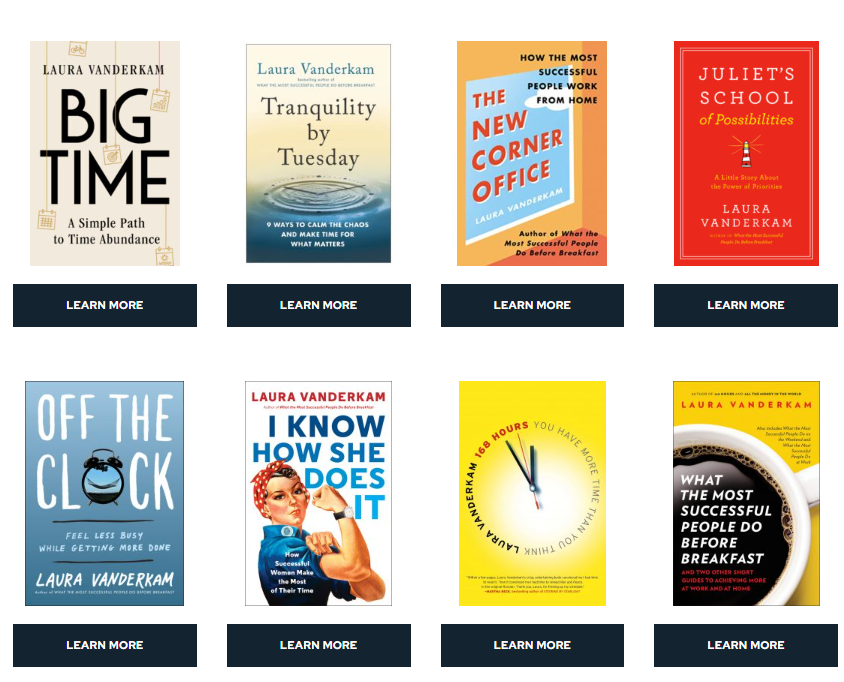
People who can prove what they preach: Laura has 10 Books!
To-do lists that actually work
Laura gets frustrated by to-do lists that can’t be finished. If you put “plan three vacations, finish a big project, research summer camps” all on one day, that’s not a to-do list. That’s a wish list.
Her rule: your to-do list should be doable. If you set lists you can finish, you make progress and feel in control of your time, rather than always feeling behind.
Break big projects into doable chunks. Assign each chunk to a specific day with a realistic time window. Only add to today what you can actually finish today.
This is the Effectiveness vector in action: doing the right things at the right time, not just piling everything onto today’s list. More on that at the Productivity Hub.
Effortful fun vs. effortless fun
One key idea from our conversation: the difference between effortful and effortless leisure.
Effortless fun is scrolling, watching, or checking social media. It’s easy and always there. Effortful fun is reading, doing a puzzle, calling a friend, or practicing a hobby. It takes a bit of effort to start.
We default to effortless fun because it’s easier. The problem is, it often leaves you feeling like the evening disappeared. Effortful fun leaves you feeling like your time was well spent.
Laura’s fix is simple: do 10 minutes of effortful fun first, then switch to effortless if you want. Either you get absorbed and keep going, or you do both and end up with a better evening.
The same idea works for mornings. Laura calls the time after work and before bed the ‘golden hours’ of the evening. That’s when you can reclaim your day or lose it to your phone.
What separates people who are in control of their time
I asked Laura what sets apart people who feel in control of their time from those who always feel behind. Her answer: intentionality.
“Time passes whether you think about where it’s going or not. You can either try to shape what fills those 168 hours, or you can let them happen.”
The weekly planning ritual is the first step. But the real change is in mindset. Shift from “I have no time” to “I have 168 hours. What do I want to do with them?” That’s Laura’s core message.
If you want to explore what’s in the way for you specifically, the Productivity Quiz takes about five minutes and shows you exactly where your system is leaking.
Laura’s new book: Big Time
Big Time: A Simple Path to Time Abundance came out on May 5, 2025. The main idea: stop seeing time as scarce and start treating it as something you can shape.
The book is based on Laura’s 279-person study. It includes frameworks for thinking about leisure, work, family, and the hours that seem to disappear.
You can find the book and all of Laura’s work at lauravanderkam.com. Her daily podcast, Before Breakfast, is about five minutes each morning. It’s worth subscribing.
Where to start with time management
Track your time for one week. That’s it. You don’t need a system or a new app. You just need data on how your 168 hours are spent.
Once you have that data, building a weekly planning ritual is easier. You’ll see where your time really goes, which stories aren’t true, and what you actually want to change.
As Laura put it: “I promise it won’t be terrible. Many people tell me it was enlightening. They found more time for the things that matter.”
Start there. Subscribe to the Productivity Newsletter for more frameworks like this every week.