

I am going to go all-in on this one: you can’t improve a week you have never measured. Nobody ever teaches you how to measure productivity when the week being measured is your own.
Twenty years in data and analytics, and every process had a baseline before we touched it. Someone mapped the hours, we found the bottleneck, fixed it, then checked if it worked. But for my own week? No number, just a blur of meetings and emails.
So I built a short assessment to put a number on it. It scores sixteen elements across Efficiency, Effectiveness, Ownership and Well-being, the 4 Productivity Vectors. Over 350 people have taken it, and I went through every answer, one by one.
Eight in ten answered for themselves, so the numbers here are theirs. The average score is 47 out of 100. The average itself doesn’t say much, but the answers underneath it do.
Productivity Assessment
Find out exactly where your productivity breaks down
Get Your Productivity Score16 questions · One click each · Score shown when you finish
A full calendar with no rule behind it
Let’s start with time. Four in ten block time for their priorities most days. One in ten says the day flows and there’s even time left to start something new. About one in eight says the day is chaos and they can’t tell where it went.
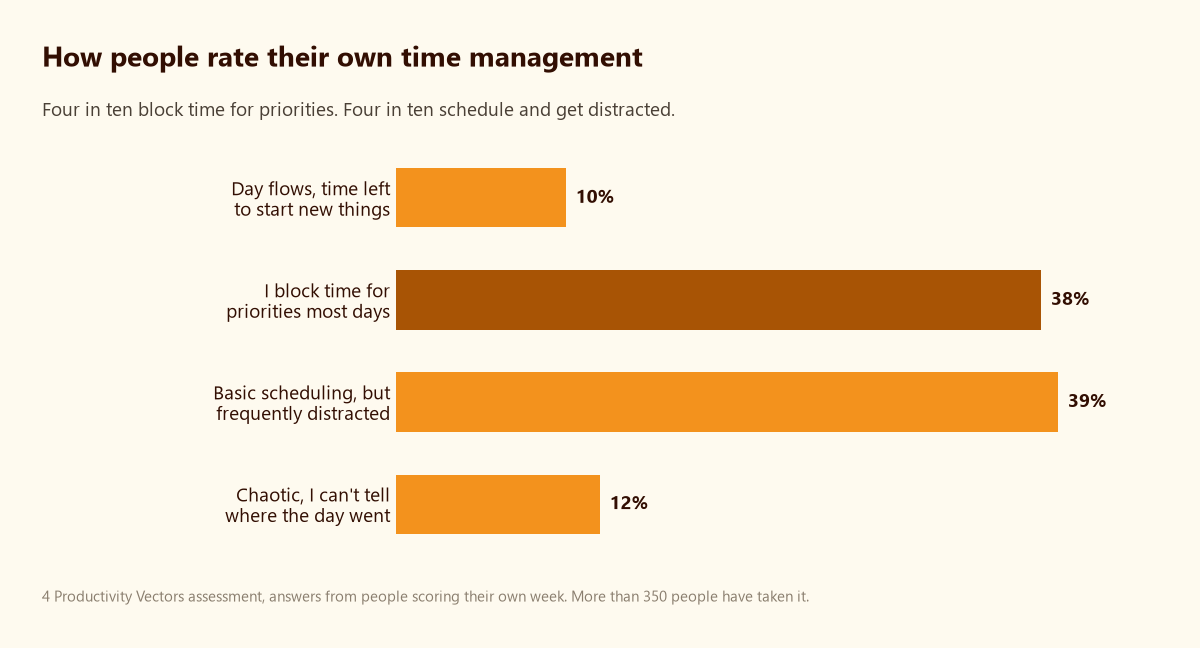
Looks like a healthy spread, right? Then comes the question: how do you decide what gets that blocked time?
The result?
Nearly half keep a basic list. One in six tackle whatever comes up. A third use a simple priority rule each day, and about one in twenty say they’ve mastered one.
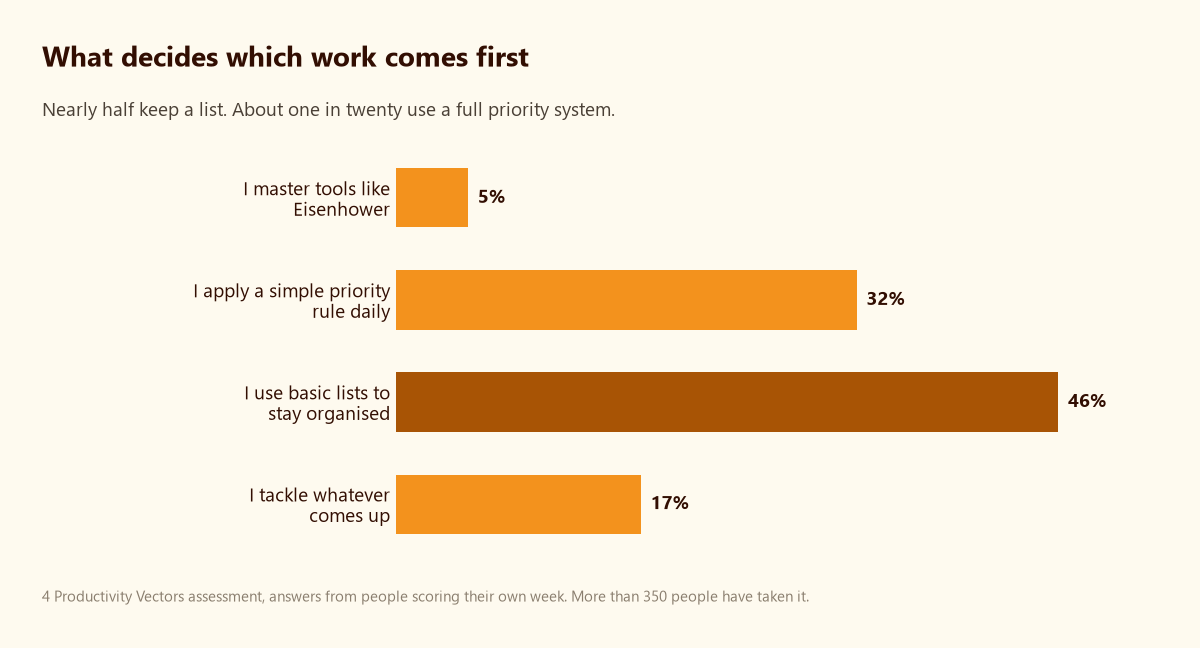
The biggest single answer on time management: “I do basic scheduling but frequently get distracted.” Three out of four who picked it have nothing beyond a list to decide what comes first. These are organised people with full calendars, but no rule for what gets the calendar first.
Goals and process tracking separate the top from the bottom
I split everyone into four groups by total score and checked which of the sixteen elements moved with the score. Time management landed in the middle.
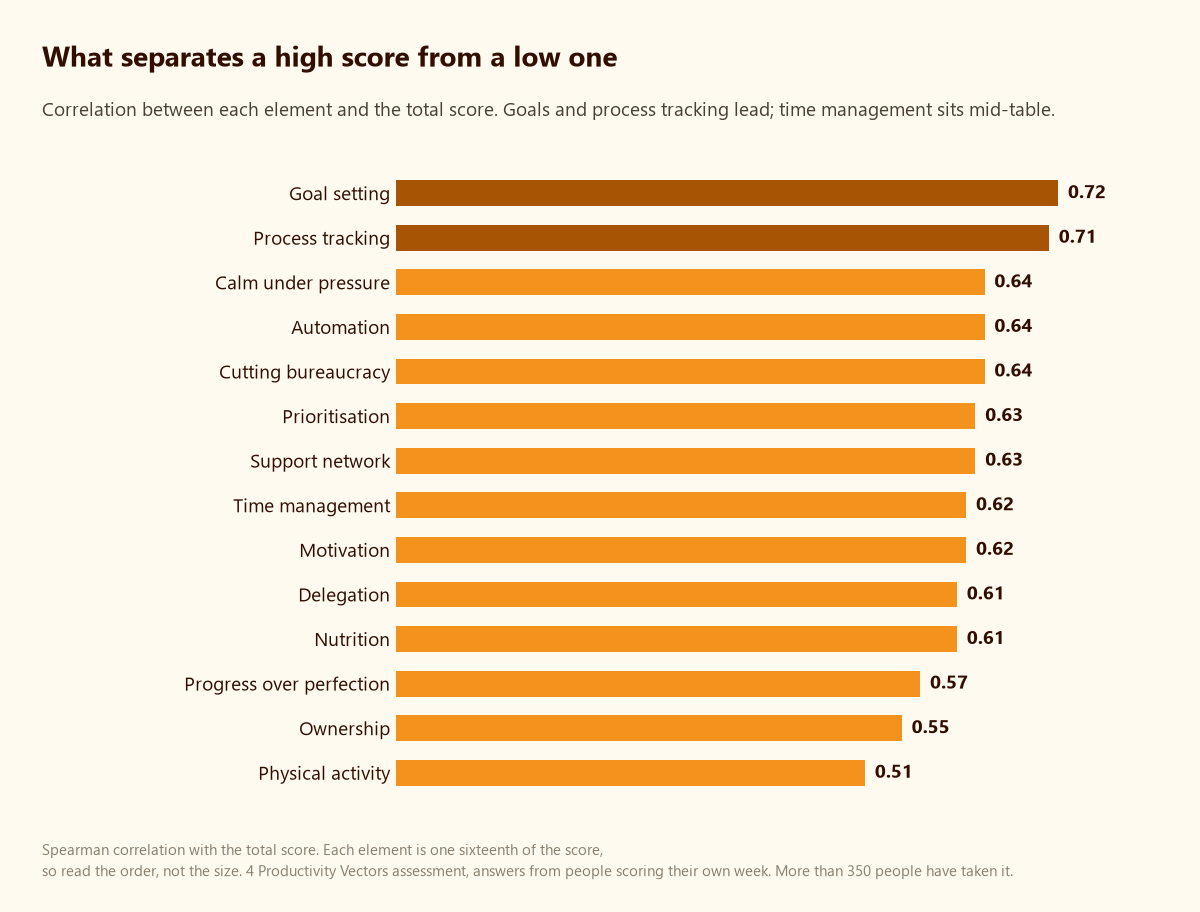
Goal setting came first, with a correlation of 0.72 to the total score. In the bottom quarter, 87 percent are weak on goals. They rarely set any, or they set them and don’t track them. In the top quarter, it’s 10 percent.
Process tracking came second, at 0.71. That’s the question about how you track and improve your own way of working. In the bottom quarter, 94 percent are weak on it, compared to 12 percent in the top quarter. Across everyone, half track their own work only sometimes, if at all, and one in ten has no way to track it.
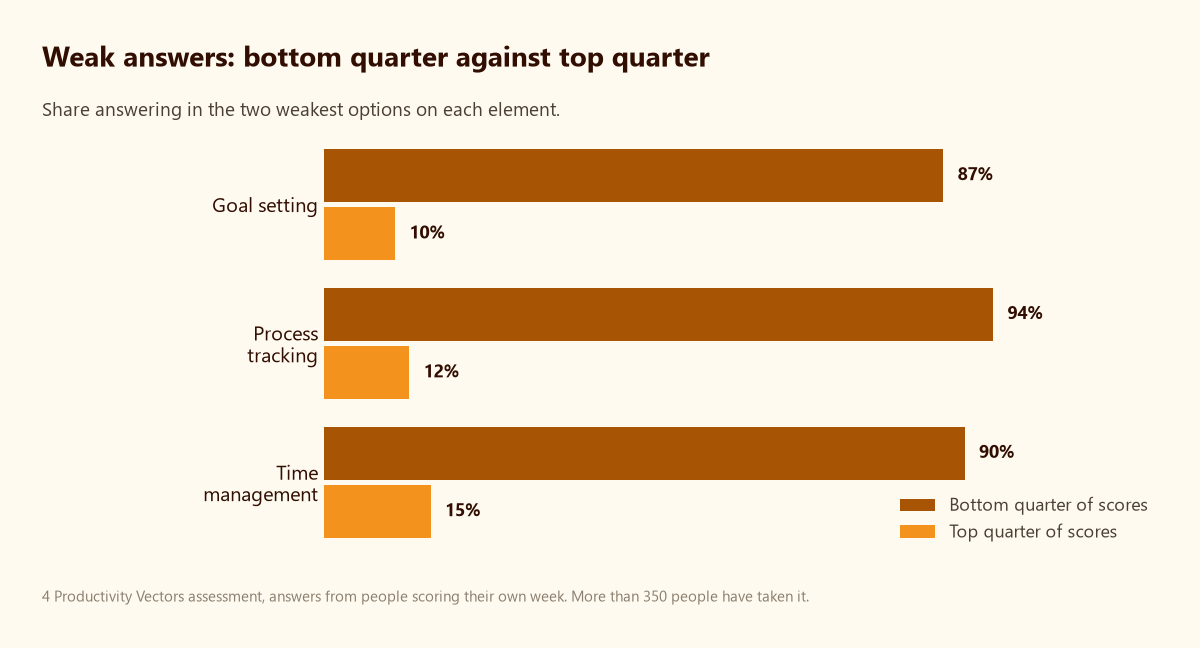
So people with high scores know what they’re aiming at, and they look at their own way of working the way a company looks at a process. My take: the calendar blocks and inbox rules only work if you have those two first.
Let me say this with a pinch of salt. Each element is one sixteenth of the score, so every element moves the total a bit. What I trust is the order: goals and process tracking lead.
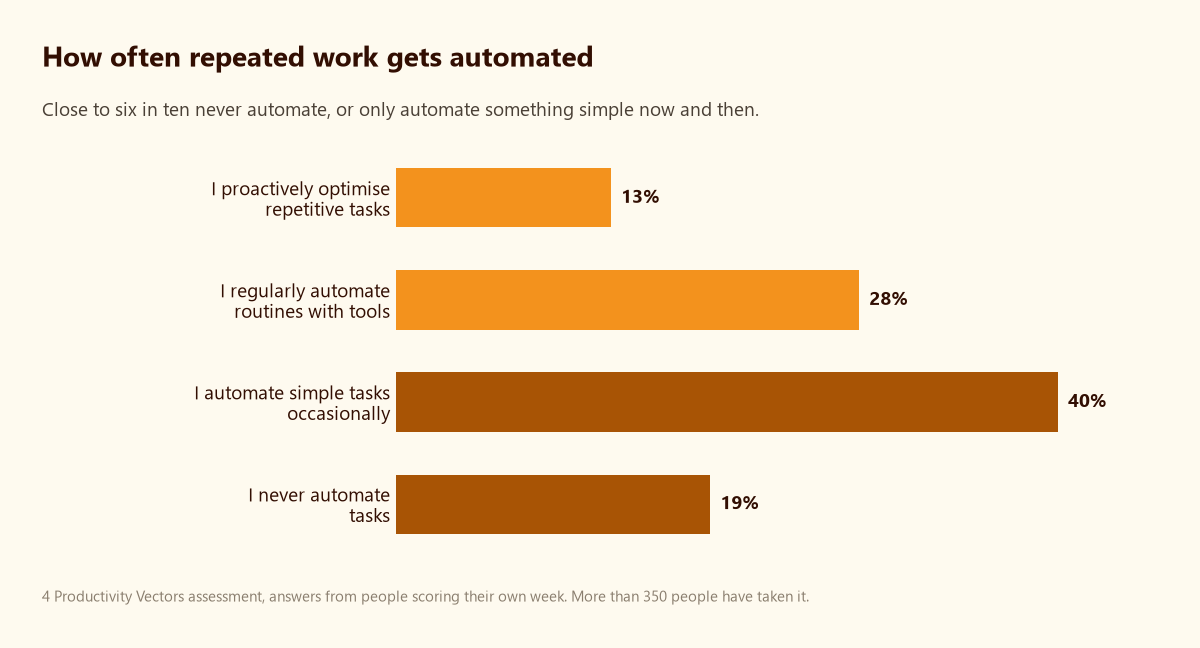
Six in ten rarely automate what they repeat
Close to one in five never automate a task. Another four in ten automate something simple, now and then. That’s nearly six in ten.
I get it. It’s the chicken-and-egg problem: too busy to stop and measure your week, but if you never stop, nothing changes.
I worked with a department of about 20 people who’d been doing email approvals forever. They knew there had to be a better way, but never had time to stop and review it. One leader assigned someone and called me in to help them move to something more efficient.
Live cohort on Maven
Productive, Not Busy
5 live sessions and 2 one-on-one sessions to create a system that makes your work enjoyable and easier to navigate. A system that puts you in control.
For managers who lead a team and still deliver their own work.
See how the five weeks runLive on Maven · Small group · Built on your own calendar and your own team

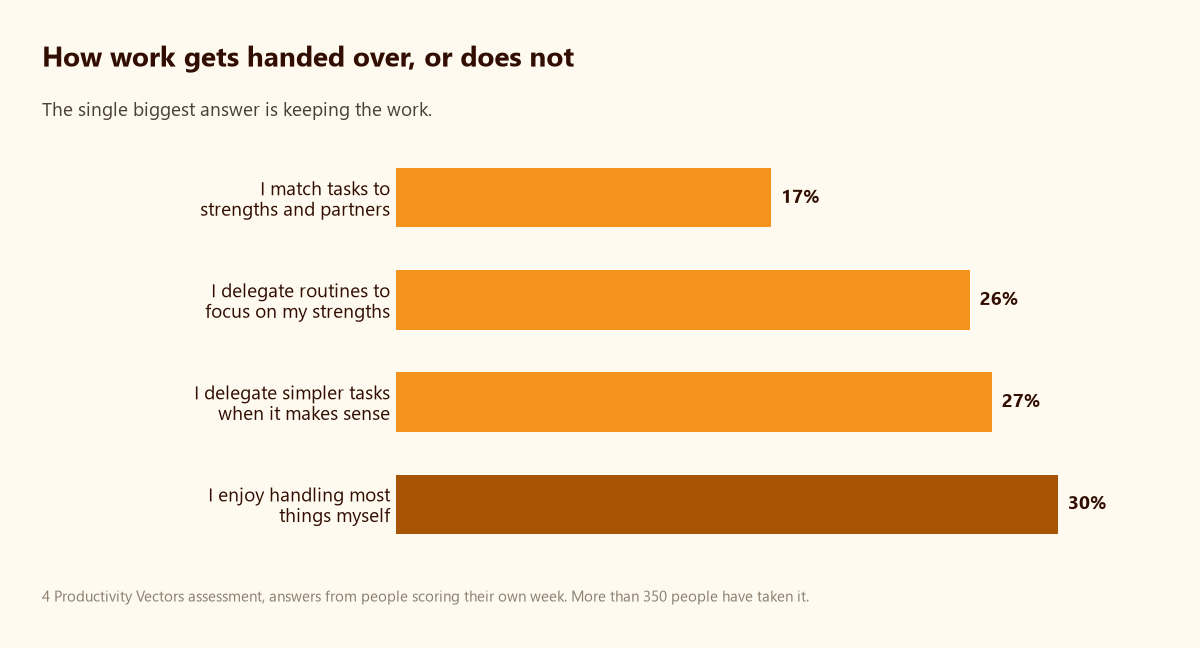
Three in ten prefer to handle things themselves
On delegation, the biggest single answer is “I enjoy handling most things myself.” Nearly three in ten chose it—more than any answer that involves handing work over.
Doing it yourself is often the sensible call on the day—it’s faster, and you know the quality. The cost shows up months later, when every approval and every question still comes to you.
How to measure productivity in your own week
So, how to measure productivity without a department behind you? Three moves, this week.
Tag one week of meetings. Create four categories in your calendar, then in every meeting, right-click and assign a category. It takes 2 seconds and gives you a data source about your own time.
Pick one thing you repeat every week, like a presentation or approvals. Write down how you do it, step by step, and how long each step takes. That’s your baseline. With it in front of you, you can decide whether to stop it, hand it over, or automate it.
Write down what you’re aiming at. Goals are where the high and low scores are farthest apart. That’s the biggest gap.
Then measure again. How will you know if you’re doing better or worse otherwise?
Over time, measuring and improving how you work becomes the most powerful habit you can build.
If you want to build that system with me instead of on your own, five live sessions and two one-on-ones, it is called Productive, Not Busy.