This free 60-day operational efficiency audit identifies exactly where your organization is losing money. Discover hidden bottlenecks, redundant processes, and inefficient workflows costing you $400K+ annually. Get a complete action roadmap to reclaim those resources immediately.
END-TO-END
What You'll Discover In Your 60-Day Operational Efficiency Audit
Over 60 days, this template systematically maps your critical business processes and identifies exactly where efficiency is being lost. You will measure the financial impact of each bottleneck. You’ll see exactly how much each inefficiency costs you per week, and which quick wins you can tackle immediately for maximum ROI.

Operational Efficiency Audit Finding: Identify Process Bottlenecks
Pinpoint exactly where your processes are slowing down. We map every step, identify redundant approvals, and reveal which delays are costing you the most money each week.
Operational Efficiency Audit Insight: Quantify Financial Impact
See the exact financial cost of each inefficiency, per week, per month, per year. Understand which improvements deliver the highest ROI so you can strategically prioritize implementation.
Operational Efficiency Audit Discovery: Uncover Root Causes
Don’t just treat symptoms. We dig deep to understand WHY inefficiencies exist, whether it’s unclear ownership, outdated systems, or poor training. Fix the real problem, not just the surface.
Build Your Implementation Roadmap
Every improvement ranked by impact and ease of implementation. Get a prioritized roadmap that tells you exactly which changes to tackle first for maximum return on investment.
Accelerate Adoption & Results
Navigate organizational change smoothly by knowing who will be impacted and how, crafting targeted strategies to overcome resistance and accelerate adoption.
Strategic Decision-Making
Make informed choices about project approach, timing, and resource allocation by having a complete picture of your stakeholder landscape and its dynamics.
OPERATIONAL EFFICIENCY
Discover Hidden Operational Inefficiencies Costing You $400K+ Annually
Most leaders don’t realize their processes are bleeding money. Hidden bottlenecks, redundant approvals, and poor workflow coordination are costing your organization $400K+ annually, money that could fuel growth and innovation instead.
The 60-Day Operational Efficiency Audit reveals exactly where inefficiencies live, why they persist, and how much they’re costing you per week. In just 60 days, you’ll have a complete roadmap to recover those lost resources and reclaim operational control.

SIMPLE & PROVEN
Get Your Operational Efficiency Audit In 3 Simple Steps
1
Map Your Critical Processes
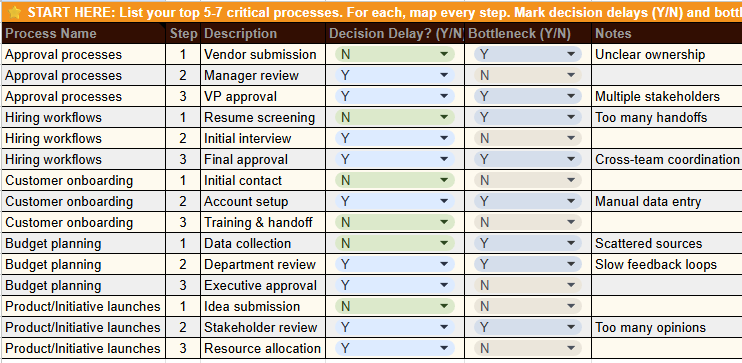
Map every critical business process end-to-end. Document workflow steps, decision points, approval requirements, and hand-offs between departments. Create visual process maps that show exactly where time and money are being lost.
2
Identify Bottlenecks & Delays
Analyze your process maps to identify bottlenecks, delays, redundant approvals, and inefficiencies. Determine which steps consume the most time and resources. Pinpoint exactly where processes break down or create unnecessary delays and cost.
3
Quantify Financial Impact
Calculate the financial impact of each inefficiency. Determine cost per week, per month, and per year for each bottleneck. Understand which improvements deliver the highest ROI so you can prioritize implementation strategically.
What You Get From Your Operational Efficiency Audit
A comprehensive Operational Efficiency Audit Template includes several essential elements that identify bottlenecks, quantify costs, and drive measurable improvements.
Process Mapping Section
First, your audit must map all critical business processes. This includes workflow steps, decision points, approval cycles, and hand-offs between departments. However, effective process mapping goes beyond listing steps. You need to understand each process’s connection to organizational goals and its financial impact on the bottom line.
Exactly 60 days. We follow a structured four-phase approach: process mapping (weeks 1-2), measurement and data analysis (weeks 3-4), root cause analysis (weeks 5-6), and roadmap development with recommendations (weeks 7-8). Your dedicated project lead keeps everything on track.
Start by brainstorming with your team to list anyone who can impact or be impacted by your project. Consider internal teams, executives, external partners, customers, and even competitors. Think broadly about direct and indirect connections to ensure comprehensive coverage.
Yes! The Operational Efficiency Audit Template is completely free to download and use. Simply enter your email address to receive instant access to the PowerPoint template, which you can customize for your projects without any cost.
Review and update your Operational Efficiency Audit findings regularly to maintain accuracy and relevance. For fast-moving projects with frequent process changes, conduct a light review of key sections quarterly. For longer-term strategic initiatives, annual updates work well. The key is to update your audit after any significant organizational change, process improvement implementation, or whenever you notice shifts in operational efficiency or cost dynamics.
Ready to Start?

How To Use Your 60-Day Operational Efficiency Audit (Step-By-Step)
Implementing your 60-Day Operational Efficiency Audit effectively requires a systematic approach. Follow these steps to maximize the ROI of your operational transformation.
Step 1: Map Your Critical Processes
Start with mapping your most critical business processes. Identify every step, decision point, approval requirement, and hand-off in your process flow. Don’t filter at this stage; capture everything that touches your operation.
Step 2: Measure Time and Cost Impact
Quantify the time spent at each step in your process. Track how long approvals take, identify bottlenecks, and calculate the cost impact of delays. Document both direct labor costs and opportunity costs. This measurement phase reveals where most of your inefficiencies are hiding.
Step 3: Identify Root Causes and Blockers
Analyze why these inefficiencies exist. Is it unclear process documentation? Lack of standardization? Poor communication between departments? Resource constraints? Conduct interviews with team members who work in these processes daily. They often know exactly what’s causing delays. Document the root causes, not just the symptoms.
Step 4: Rank Improvements by Impact and Effort
Not all improvements are created equal. Some offer massive cost savings but are difficult to implement. Others are quick wins. Build a prioritized roadmap that addresses high-impact, low-effort improvements first. This creates momentum and demonstrates value early. Then tackle the more complex transformations.
Step 5: Build Your Implementation Timeline and Communication Plan
Create a detailed timeline for rolling out improvements. Who needs to be involved? Which teams will be impacted? What training is required? Build a communication plan that keeps stakeholders informed and engaged throughout the transformation. Success depends not just on good ideas, but on getting people aligned and motivated to execute.
Common Operational Efficiency Mistakes To Avoid
Even experienced operations leaders make critical errors when auditing for efficiency. Avoid these common pitfalls to maximize your audit’s effectiveness.
Incomplete Process Discovery
The most frequent mistake is failing to identify all relevant processes. Many teams focus only on obvious processes while missing critical hand-offs, approvals, or support functions that add cost and delay.
How Operational Efficiency Drives Better Decision-Making
Operational efficiency improvements drive better decisions by providing clear, data-driven insights into process performance and cost impact. When leaders understand exactly where inefficiencies exist and their financial consequences, strategic choices become easier and more effective.
Identifying Process Bottlenecks Early
Your operational efficiency audit maps all critical processes and identifies exactly where delays occur. These bottlenecks become visible immediately, showing you which processes must be improved first. With clear bottleneck identification, you can prioritize improvements strategically based on financial impact and implementation ease.
Understanding True Cost of Delays
Operational inefficiencies have specific financial costs. When you quantify the cost of delays, you can make informed trade-offs between speed and resources. Understanding the true cost of each bottleneck helps you decide which improvements deliver the highest return on investment.
Visualizing Process Interdependencies
Complex operations involve processes with hidden dependencies and hand-offs between departments. Mapping these dependencies reveals where one department’s delays create bottlenecks for another. This visibility enables you to address systemic issues rather than treating isolated problems.
Building Consensus Around Priorities
When improvement roadmaps are ranked by financial impact and implementation effort, leaders across departments can align on priorities. Data-driven prioritization reduces political debates about which changes to implement first, accelerating decision-making.
Best Practices For Implementing Your Operational Efficiency Audit Results

Implementing the recommendations from your 60-Day Operational Efficiency Audit is critical to achieving results. These best practices ensure successful execution and sustained operational improvements.
Start with Quick Wins
Begin implementation with the quick wins identified in your audit, changes with high impact and low complexity. These early wins build momentum, demonstrate value to the organization, and secure stakeholder buy-in for larger, more complex improvements.
Establish Clear Ownership
Assign clear ownership of each improvement initiative. Identify a single accountable leader responsible for implementation, timeline, success metrics, and removal of blockers. This eliminates confusion and accelerates progress.
Track Progress Regularly
Monitor implementation progress against your roadmap. Hold regular review meetings to assess progress, identify obstacles, and adjust timelines as needed. Visible progress maintains momentum and adjusts focus based on what’s working.
Communicate Results
Share improvements and cost savings across the organization. Demonstrate the financial impact and resource reclamation that efficiency improvements deliver. This visibility drives organizational alignment and builds support for additional changes.
Build New Processes
Don’t just eliminate inefficiencies, establish new, streamlined processes. Document the improved process, train teams on new workflows, and ensure systems support the new way of working. Process documentation prevents regression and reduces training time for new employees.
Get Your Complete 60-Day Operational Efficiency Audit
Ready to recover $400K+ in hidden operational costs? Start your 60-Day Operational Efficiency Audit today and get a complete action roadmap to eliminate bottlenecks, reduce unnecessary costs, and reclaim capacity for strategic work.
What’s Included in Your Audit:
Our comprehensive 60-Day Operational Efficiency Audit includes everything you need to improve your operations. You’ll receive a complete process map showing:
- Processes (Week 1-2)
- Map every critical business process end-to-end. Document each step, decision point, approval requirement, and handoff between departments.
- Measurements (Week 3-4)
- Measure time spent on each activity. Document processing times, approval delays, handoff intervals, and total cycle time. Identify where time is wasted.
- Root Causes & Roadmap
- Analyze why inefficiencies exist. Investigate unclear processes, lack of standardization, poor communication, and resource constraints. Rank improvement opportunities by impact and ease of implementation.
- Before/After Outcomes
- Implementation Timeline
- Detailed schedule for implementing improvements. Identify quick wins (0-30 days), medium-term initiatives (1-3 months), and long-term transformations (3-6 months). Assign ownership and set clear milestones.
Show the transformation from current state to improved state. Include metrics on time saved per transaction, annual cost reductions, quality improvements, and team capacity freed for strategic initiatives.