It’s Monday morning, and you open your laptop. Last week was a nightmare: unpredictable meetings, escalations, late approvals, and constant rushing. Today, you decide to learn how to plan the week differently. You look at your calendar and start planning. You add productivity blockers to protect your quality time, leave time for meetings, and set up one-on-ones with your team. The cherry on top? A list of three goals to accomplish this week.
Less than an hour later, the tsunami of reality hits. A VP launches a new project and wants you involved. You received six workshop invites this week, each lasting 2 hours. One team member asks to reschedule your one-on-one. Another 10 emails hit your inbox with “important” and “urgent” tasks.

Why Learning How to Plan the Week Matters
For many people, this chaos is everyday. They consider it their job to defer, deflect, or absorb all this work, no matter what, because that’s what they’re paid for. However, if you’ve ever felt truly productive and understand what productivity means, this story will upset you. You tried to prepare your week for maximum productivity, but soon after, your plan is shattered.
So what should you do? Should you give up on setting goals and planning for work? Or should you accept that “this is what I’m paid for”?
The truth is, it’s easy to let go and fit in. This is what most people do, and it’s precisely why corporations are so unproductive. Everyone goes with the flow. However, when your work consists of emergencies with no planning or prioritization, you’re not only harming yourself; you’re also harming your team and the company’sproductivity.
That’s why you, as a leader, should be one of the first to say stop. Yet saying stop isn’t easy because this is a wrecking train moving at high speed, ramming anything in its path. You might call it corporate culture or short-termism. I’ll leave that to you.
It’s a fact that we live in a time of short-sighted thinking. Vision and mission seem secondary because there’s a rush to produce and focus only on the next couple of months. Nevertheless, there are steps we can take to optimize time management and team productivity as we navigate this frenzy.
How to Plan the Week for Unexpected Chaos
The way to plan your week for the craziness ahead is to buffer for unexpected things. You shouldn’t fill your week with meetings and work blocks to design a perfect plan, because disruptions will happen.
Therefore, one key time-management strategy I recommend is creating emergency blocks on your calendar. Many people hesitate to block time on their calendars because they fear it will go unused if unexpected events do not occur (this stems from the nonsensical need to fill the agenda)
However, there’s nothing healthier than having a spare hour or two in your day. This time is highly useful for reviewing your strategy and examining data, reports, or analytics, or simply grabbing a coffee with a colleague you want to catch up with. These are things leaders rarely have time to do because they’re busy in the meeting cycle.
Don’t be afraid of having spare time in your day. It’s a very healthy thing.
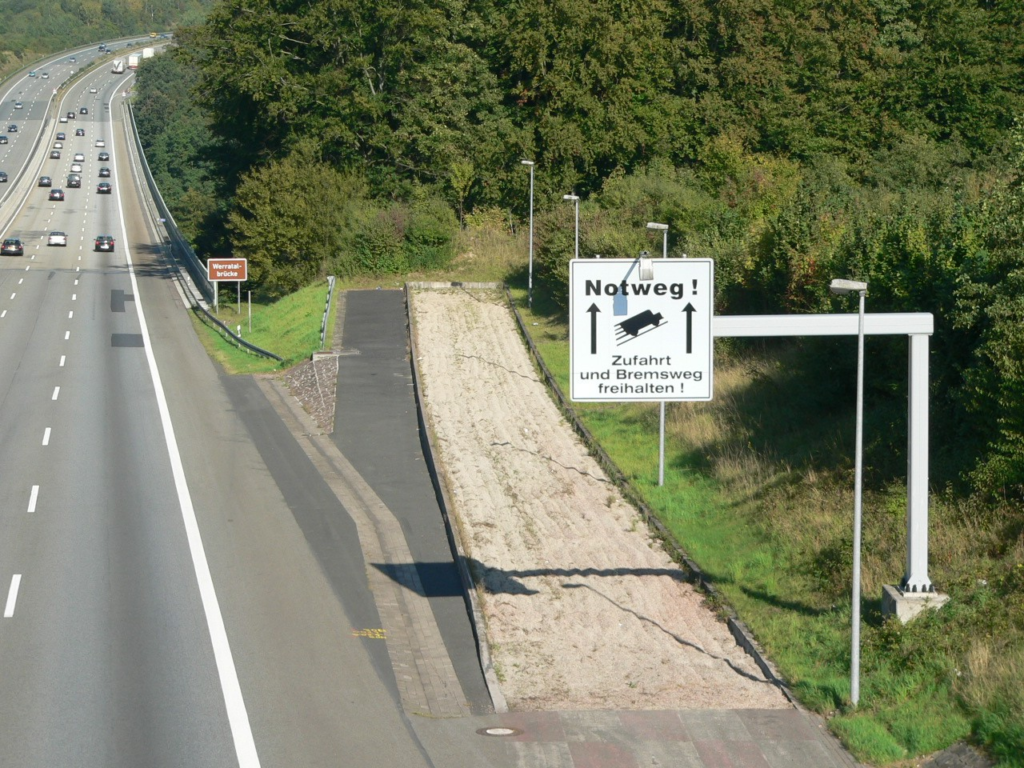
Truck Escape
How to Plan the Week for Peak Energy
The second step is to plan our energy. People have different energy cycles. Most people have more energy in the morning, while others are more active in the afternoon or evening.
If you work in a global setup, you need to carefully manage your energy because you’ll likely have meetings or work with people around the world, day or night. Therefore, plan your week and quality time around your energy peaks.
Identify Your Peak Performance Hours
For example, I’m very energetic in the morning. From 7:00 AM to 11:00 AM is my peak of creativity, supported by a bit of caffeine. This is when I block time to do meaningful work. I develop strategies, consider how my team can improve, and prepare for upcoming work presentations, proposals, and data architectures.
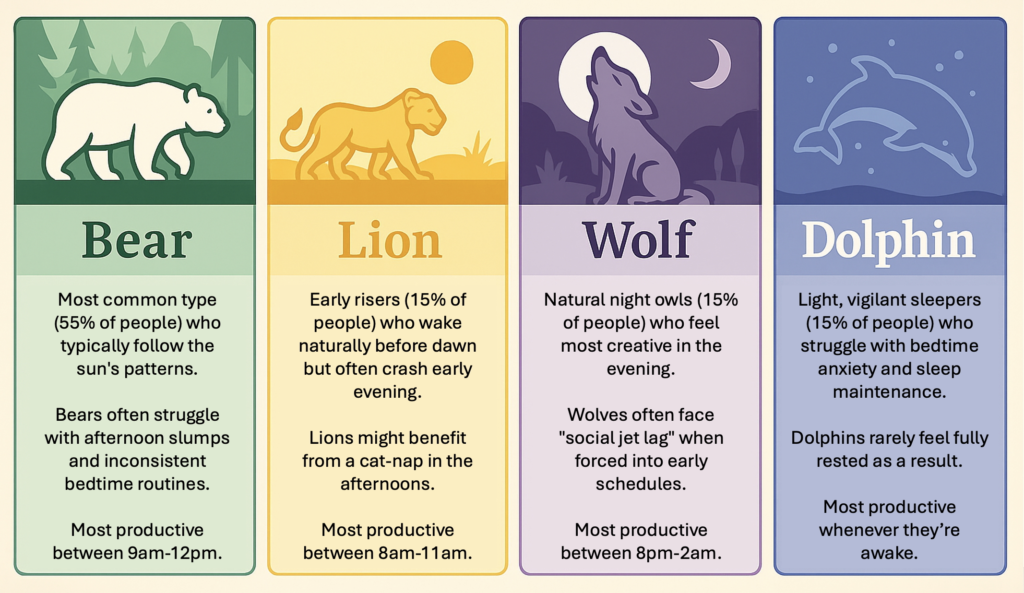
Whatever requires a lot of brainpower, I do in the morning. I leave in the afternoon for meetings. It’s not that meetings don’t require brainpower, but it’s generally easier to follow conversations than to sit alone and think through complex problems.
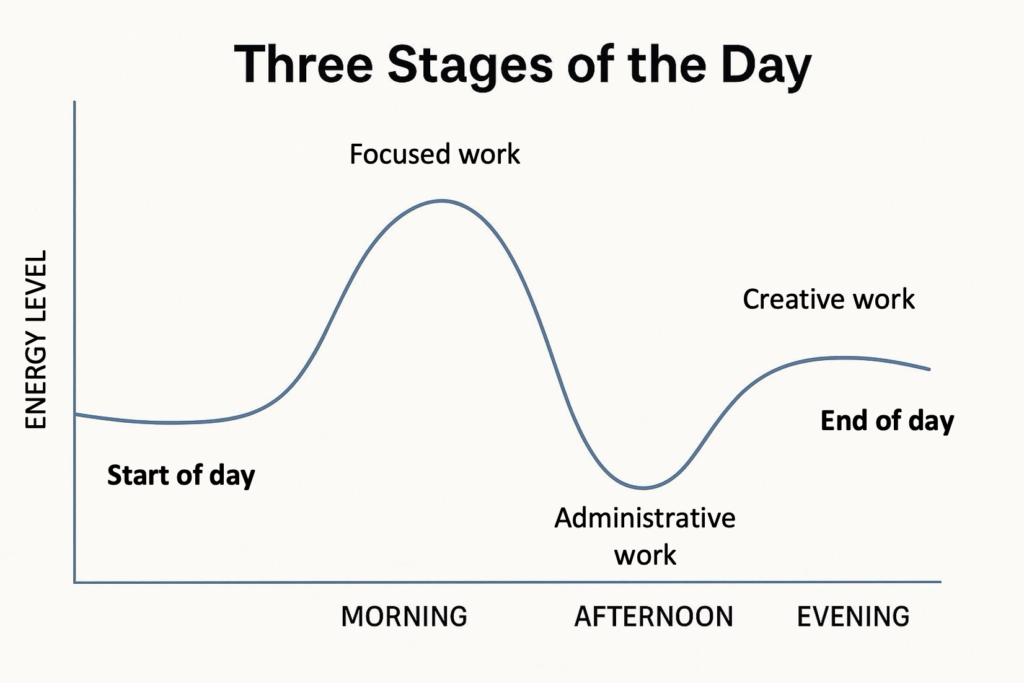
These are principles. That doesn’t mean you can’t take a meeting in the morning. Of course, this will happen. However, make it a habit to dedicate your peak brainpower hours to meaningful work.
How to Plan the Week for Maximum Effectiveness
A critical part of planning your week is having a clear view of what you’re trying to achieve. This is the most essential part of effective time management and decision-making.
For example: “This week I will complete these two things. I need that much time. To get it done, I’ll need to meet with XYZ to unlock budgets and then with the team to confirm the plan. Then I’ll need another hour to formalize all the agreements made during the week, so by Thursday, the plan is completed, agreed, and ready to roll the following week.”
Block Time Intentionally
You need to block all these times in your calendar intentionally:
- One hour: meet stakeholders
- One hour: meet with the team
- One hour: formalize the outcomes
- One hour: prepare the success criteria
Intentionality is the key to having a productive week. You know what you’re trying to achieve and work toward it intentionally. Will you achieve it? Maybe yes, maybe no. However, at least it’s intentional, and this is a skill that improves week after week.
Therefore, before opening emails or seeing meeting invites, sit down (probably with your computer off) and decide on the one or two things you want to accomplish this week. I don’t recommend listing 25 tasks because people tend to be overoptimistic when planning.
For more on prioritization and decision-making frameworks, check out my free productivity resources that can help you assess your current productivity levels.
How to Plan the Week with Calm and Composure
Another essential element when going through a week you’ve previously planned is how to stay calm when things go in a different direction.
The Power of Calm Decision Making
On a routine night flight from Kuala Lumpur to Perth on June 24, 1982, British Airways Flight 009 sliced through the calm darkness over the Indian Ocean south of Java. Captain Eric Moody and his crew, First Officer Roger Greaves and Flight Engineer Barry Townley-Freeman, were cruising at 37,000 feet in their Boeing 747 when a faint haze appeared ahead, unnoticed as the ash cloud from Indonesia’s Mount Galunggung volcano.
Suddenly, the engines surged with violent bangs, flames flickering in the dark. One by one, all four Rolls-Royce RB211 engines flamed out, starved of oxygen by the abrasive ash, transforming the jumbo jet into a silent glider with a 15:1 glide ratio. Moody issued a Mayday to air traffic control, then turned to the 263 passengers with unflinching calm: “Ladies and gentlemen, this is your captain speaking. We have a small problem. All four engines have stopped. We are doing our damnedest to get them going again. I trust you are not in too much distress.”
Descending rapidly to 13,500 feet for breathable air, the crew ignored standard checklists and restarted the engines as the ash cleared from the compressor blades. Number four surged again and was shut down, but the remaining three roared back to life. Blinded by sandblasted windscreens that turned the forward view to frosted obscurity, they relied on instruments to thread the needle into Jakarta’s Halim Airport, touching down safely with no injuries.

The miracle flight set a Guinness World Record for the longest glide by a commercial airliner and revolutionized aviation safety, prompting the deployment of global volcanic ash detection systems and the closure of airspace. Moody and his team earned the Queen’s Commendation for Valuable Service, their poise turning near-catastrophe into legend.
The moral of this story isn’t just about technical skill. It’s about leadership under extreme pressure. It’s about how Captain Eric Moody’s focus on people, his ownership of the situation, and his unshakeable calm saved 263 lives that day. Panicking would have helped nobody. Instead, his composure became the anchor that held everything together.
Similarly, when you receive invites for six workshops this week that you hadn’t planned and that will derail your agenda, think about two things:
1. Prioritization: Do you really need to be in the workshops?
2. Stay: If so, how can you replan your week to accommodate them?
There’s no need to shout or react with an email saying, “This comes very last minute.” Of course, you can express your opinion and suggest doing better next time. When you attend the workshop, say something like, “It would have been beneficial to know about this before.” But that’s it. Life is life. Move on.
If you want to learn more about staying calm in stressful situations, I recommend listening to my interview with Bradley Lord, the F1 Head of Communication for the Mercedes-AMG Petronas team.
He made one of the calmest decisions in history in 2021, when, in the final Grand Prix in Abu Dhabi, Lewis Hamilton lost the title to Max Verstappen on a controversial race-control decision.
How to Plan the Week with the Right Meeting Types
When creating meetings, it’s easy to fall into the trap of standards: “All my meetings are half an hour” or “All my meetings are one hour.” This is a massive mistake because every meeting type requires a different duration, agenda, and energy
See below for a complete cheat sheet of meeting types and when to use each.
How to Plan the Week by Saying No
The first reaction we have as humans, because we connect with others and likely know the people who invite us to meetings or who are our superiors, is to say yes. I will attend.
I urge you to think twice and use the golden rules for meetings.
Golden Rule Number One: No Agenda, No Meeting
If there is no agenda, there are two options:
- The requester forgot to add it. Kindly ask them to add it before accepting.
- The requester isn’t clear about what they want to discuss or achieve. In this case, the best action is to politely reply that it would be better to review some information or receive a brief before scheduling a meeting. That meeting is very likely to be a waste of time.
For the sake of your time, which is the only thing you cannot recover in life, before you say yes to the next meeting and spend 30 minutes with your camera off looking at your emails, think: Do we really need this meeting?
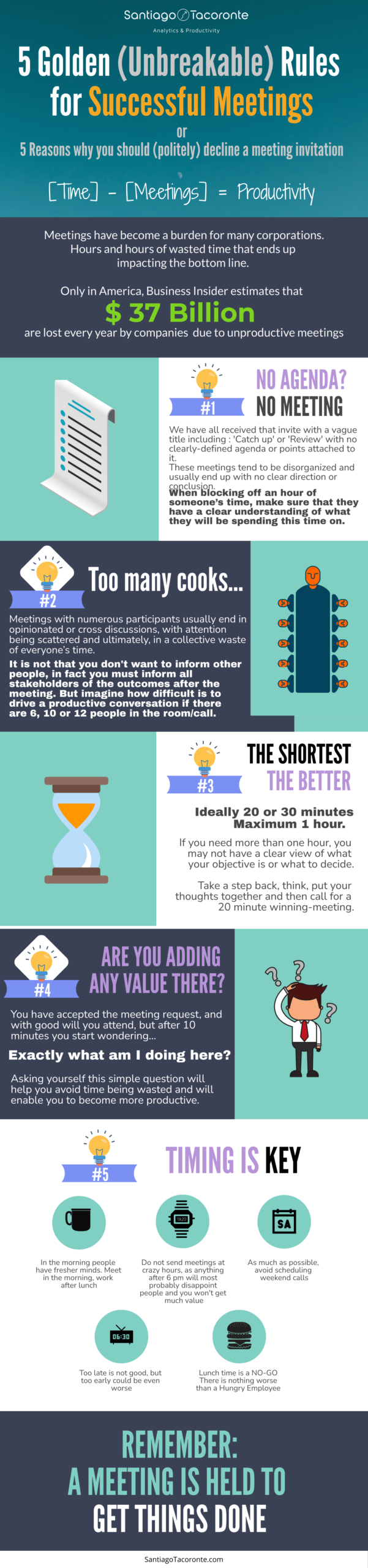
Again, these are principles, not mandates. There might be a case where you need to attend a m100-person meetingbecause it’s an all-hands, and that’s okay. However, you shouldn’t participate in a decision meeting with 20 people in the room.
How to Plan Your Week with Automation and AI
Last but not least, include process automation and AI in your weekly planning. This one is more strategic and long-term. It’s easy to overlook because, at the planning level, you don’t want to get into the weeds of solutioning versus planning. However, when you review your week and calendar, you will find that many Things can be automated. Here are a few examples:
1. Approvals
This is something every leader needs to do. It takes time and typically involves many back-and-forth touchpoints via email, spreadsheets, and Teams messages. Please take a look at my MS365 Automation course to eliminate approval bottlenecks once and for all and make it simple and straightforward.
2. Meeting Notes
Make the most of AI recognition and summarization tools in your company. Taking meeting notes is a thing of the past because AI can do it quite well, not only taking notes but also summarizing and creating actions.
3. Email Dispatching
Write all the important emails you need to dispatch during your peak time when your brain is most active (manage your energy, remember). Then schedule them for dispatch at the right time, when you know the recipient ismore likely to open, read, and take action.
4. Canned Responses
If you’re a manager, you likely receive the same questions every week: What is the process for doing this? How can I get approval for that? Who do I need to contact?
Using shortcuts and canned response tools like Text Blaze or the super-powerful RayCast can automate these responses, saving significant time.
Conclusion: Master How to Plan the Week
Planning your week is essential to productivity. Yes, your plan will likely be disrupted 80% of the time. However, that’s okay because intentionality counts. Over time, your week will surely become more productive.
So remember to:
- Protect your time by saying no or sharing updates by email.
- Plan for your energy so your peak hours correlate with quality work.
- Buffer for craziness by leaving emergency blocks.
- Automate the things that happen every week.
This probably painful exercise at the beginning will turn you into a master of your destiny. You’ll be in control of your agenda. You’ll have quality time to lead rather than be pulled in all directions.
And when you get this done? I’ll tell you, oh boy, this is a great feeling.
Ready to Take Control of Your Week?