

Wondering how much time your team wastes in meetings? The average office worker spends 23 hours per week in meetings.¹ That’s not an exaggeration. That’s research-backed data from Flowtrace’s 2025 State of Meetings Report.
For a 10-person senior director team earning an average of $150,000 per year, here’s the math:
23 hours × 10 people × $72/hour (pro-rata salary) × 52 weeks = $855,360 annually
Here’s what makes it worse. Most leaders I work with tell me their teams spend 15+ hours per week in meetings but make only 2–3 real decisions. That means each decision costs $300,000+ in meeting time alone.
If you could cut meeting time by just 40% (which most optimized teams achieve), you’d save $340,000+ per year for that 10-person team. Plus, you’d get faster decision-making, more focus time, and significantly happier people. That’s not theory. That’s what I’ve seen work, and it connects directly to the operational inefficiency I wrote about recently.
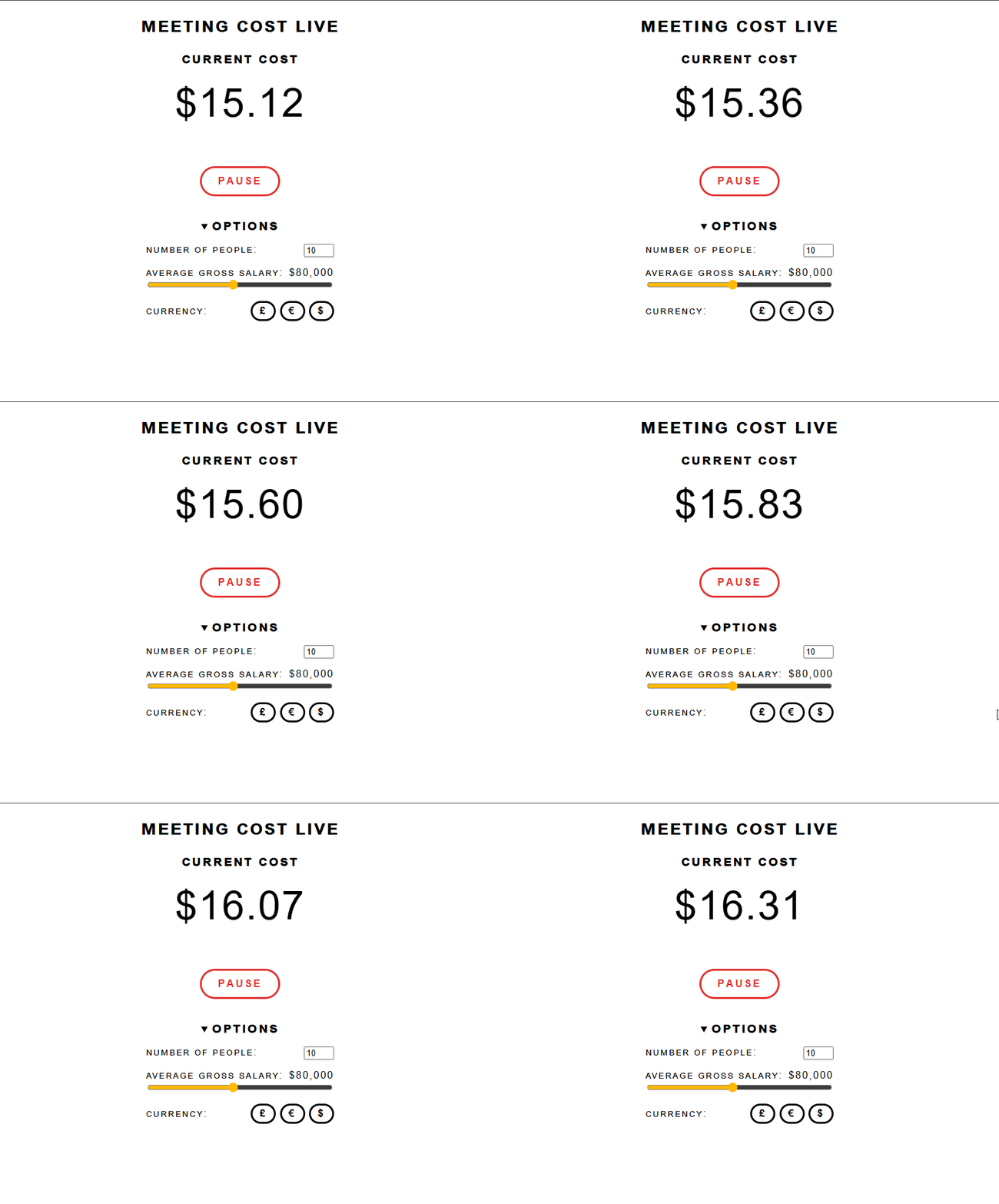
Try this Meeting Cost Live Calculator by Simon Legg to show in real-time what a Meeting is costing.
The Real Cost of How Much Time Your Team Wastes in Meetings
Let’s be specific. The meeting problem isn’t abstract, it’s measurable. Here’s how to calculate how much time professionals waste in meetings inside your own organization.
The Formula
Hours in meetings per week × Hourly rate × Number of people × 52 weeks = Annual cost
Example: 10-Person Senior Director Team
- 15 hours per week in meetings (average).
- 10 people on the team.
- Average hourly rate: $100/hour ($200K salary ÷ 2,000 work hours).
- 15 × $100 × 10 × 52 = $780,000 per year.
Now add the hidden costs that nobody talks about:
- Rework from unclear decisions: +$100,000. When nobody leaves a meeting with clear next steps, work gets done twice.
- Context-switching delays: +$150,000. Jumping between meetings kills focus. Research shows managers lose 40% of daily productivity this way.²
- Meetings that should have been emails: +$100,000. According to Fellow’s research, 55% of remote workers believe most meetings could be replaced by an email.
Total annual cost: $1.1 million for one 10-person team.
Think about what that money could buy instead: a senior operations hire, a business analyst, a project manager, and new automation tools, all for less than what you burn on meetings nobody wanted.
The Competitive Disadvantage When You Don’t Fix How Much Time Your Team Wastes in Meetings
Teams drowning in meetings move more slowly. Decisions take longer. Focus time disappears. Your best people get frustrated and eventually leave. I’ve written extensively about this pattern in my piece on why high performers leave. Excessive meetings are often the silent killer.
Compare that to well-run teams. Their meetings are rare, focused, and end with decisions. They move 2–3x faster. They attract better talent. They ship products and initiatives on time. The meeting problem isn’t just about time. It’s about whether your organization can move fast enough to compete.
Why How Much Time Your Team Wastes in Meetings Keeps Growing (4 Root Causes)
Before you can reduce meeting time, you need to understand why your calendar looks the way it does. In my experience coaching leaders, the problem comes down to four root causes.
Reason 1: Unclear Decision Rights
Nobody knows who decides what. So everyone gets invited to everything.
You want to decide on a vendor? Better include procurement, finance, the team leads, and the department head. You never know who actually needs to decide, so you invite everyone. The result? Ten people in a room for a decision that should involve two or three. Meeting time per decision: 5 hours. Cost per decision: $500+.
The fix: Define decision rights clearly. “The operations manager decides on vendors under $10K. The VP decides on larger vendor changes. Finance signs off on payment terms.” Clear ownership cuts meetings in half.
Reason 2: Meetings Replace Clear Communication
The default in most organizations is “let’s talk about this in a call” instead of “let me send you a detailed recommendation.”
A status update that should be a Slack message becomes a 30-minute meeting. A planning discussion that should be a shared doc with comments becomes a 60-minute workshop. A decision that should be an email with three options and a recommendation becomes a recurring weekly sync. The result: 5+ hours per week wasted on meetings that could be 30 minutes of reading.
The fix: Default to async communication. Meet only when a real discussion is needed. If you’re looking for practical ways to reclaim your calendar, my guide on how to plan the week covers this in depth.
Reason 3: No Agenda or Clear Outcome
Meetings happen because they’re on the calendar. Nobody knows the goal. Nobody knows what decision needs to be made. According to Flowtrace, 64% of recurring meetings have no agenda at all.³ The result? Meetings that meander, run long, and end without clarity.
The fix: Every meeting must have four things: a goal, a decision to be made, the right attendees for that decision, and a set duration. Period. If you can’t articulate the goal in one sentence, cancel the meeting.
Reason 4: Weak Meeting Culture
“Let’s add another meeting” is the go-to solution for everything. Nobody protects focus time. Meetings get scheduled at 4 PM just because there’s an opening. The result: fragmented days with no deep work time and people working late to actually focus.
The fix: Create designated meeting blocks (e.g., Tuesday/Wednesday 9–12 only). Protect focus time the same way you’d protect a client call. Monday and Thursday afternoons? No meetings. Non-negotiable.
5 Warning Signs How Much Time Your Team Wastes in Meetings Is a Problem
Not sure whether your meetings are the problem? Here’s a quick test. If you recognize two or more of these signs, your team is losing significant time and money.
Sign 1: No Clear Goal or Decision
You leave the meeting and someone asks, “Wait, what did we decide?” Nobody knew the goal going in. This is a red flag that the meeting wasn’t necessary, or it was poorly designed.
Quick fix: Every meeting starts with one sentence: “Goal: ___” or “Decision: ___.” If you can’t fill in the blank, the meeting shouldn’t happen.
Sign 2: 80% of Attendees Aren’t Talking
Ten people in the room. Two are talking. Eight are sitting there with nothing to contribute. Atlassian’s research confirms that 54% of workers leave meetings unclear about next steps or ownership.⁴
Quick fix: Smaller attendee lists. The default question before every invite should be: “Does this person actually need to be here?”
Sign 3: Meetings Always Run Over
Every meeting ends 5–10 minutes late. Topic creep takes over. This cascades delays into the next meeting and shows a lack of respect for people’s time.
Quick fix: Hard stop at 25 minutes if you booked 30. Build in a 5-minute buffer. Treat the schedule like a client call. because it should matter just as much.
Sign 4: Follow-Up Emails Contradict the Meeting
The meeting happened. Then someone sends an email: “Actually, we decided to do X.” This means the decision wasn’t clear during the meeting. People left with different understandings.
Quick fix: Write down the decision before leaving the room. Confirm it in the follow-up email. No ambiguity.
Sign 5: Attendees Are Multitasking
People are on laptops and phones during the meeting. They’re clearly not engaged. According to Flowtrace, 92% of workers multitask during virtual meetings.⁵ That tells you everything about the perceived value of those meetings.
Quick fix: Establish a no-laptop rule for in-person meetings. For virtual ones, reduce the attendee list or shorten the meeting. If people aren’t engaged, the meeting isn’t working.
Your 30-Day Playbook to Cut How Much Time Your Team Wastes in Meetings
Week 1: Audit Your Current Meetings
Have your team log every meeting for one week. For each meeting, capture:
- Meeting name and duration
- Number of attendees
- Whether a decision was made (yes or no)
- The outcome
- Could this have been an email, Slack message, or shared doc?
Goal: See the patterns. Most teams discover that 40–50% of their meetings add no real value.
Week 2: Establish Your Meeting Rules
Based on the audit, create your team’s Meeting Rules. Here are examples that work:
- All meetings need a goal, a decision, the right attendees, and a set duration.
- Maximum 30 minutes. No 60-minute meetings that should be 30.
- Status updates go to email. Sync only when discussion is needed.
- Recurring meetings get a quarterly review. Kill the unnecessary ones.
- No meetings after 4 PM (protect focus time).
- No back-to-back meetings. People need breaks.
Week 3: Implement the Changes
This is where the real transformation happens. Start by cancelling recurring meetings that don’t support decisions. Move your weekly standup to an async update with an optional 15-minute huddle. Replace monthly “syncs” with a quarterly all-hands only.
Then, reschedule remaining meetings into designated blocks, for example, Tuesday and Wednesday mornings only. Protect Monday and Thursday afternoons as meeting-free focus time. Move all status updates to Slack or email.
Expected result: Meeting load drops by 30%.
Week 4: Review, Optimize, and Lock It In
Check in with your team. How does the new schedule feel? Which meetings turned out to be valuable after all? Which ones did nobody miss?
Tweak based on feedback. Measure two things: time savings and decision quality. If decisions are happening faster with fewer meetings, you’ve found the right balance.
Expected result: Stable at 40% fewer meetings with stronger decision-making.
Before vs. After: See How Much Time Your Team Wastes in Meetings vs. After the Fix
Here’s what a real meeting reduction looks like in practice.
Team Example: Manufacturing Operations (10-Person Team)
Before:
- 18 hours/week in meetings
- 2–3 decisions per week
- Cost per decision: $1,200
After (30 days):`
- 11 hours/week in meetings
- 5–6 decisions per week
- Cost per decision: $400
Result: 40% fewer meetings, 2x more decisions, and $300K+ in annual savings. The team regained 3–5 hours of focus time per person, per week.
This isn’t unusual. I’ve seen similar results across industries. The pattern is consistent: fewer, more focused meetings produce faster decisions and happier teams.
Your Next Step: Cut How Much Time Your Team Wastes in Meetings
Your team doesn’t hate meetings. They hate ineffective meetings that waste time. They hate unclear decisions. They hate multitasking because they’re stuck in meetings instead of doing real work.
You can fix this. In 30 days, using this playbook, most teams cut meeting time by 40% while actually improving decision-making. The payoff: 3–5 hours per week of reclaimed focus time, faster decisions, and significantly happier people.
Start here: Take the 4 Vectors Productivity Assessment to see where your team stands on efficiency, effectiveness, ownership, and well-being. It takes 5 minutes and gives you a clear baseline before you start the meeting audit.
Sources
¹ Flowtrace (2025). State of Meetings Report 2025. Executives spend 19+ hours per week in meetings; managers spend 16 hours. Employees spend 392 hours per year in meetings.
² Myhours.com (2025). Meeting Statistics for 2025. Senior managers spend an average of 23 hours per week in meetings. Executives dedicate 1,196 hours annually.
³ Flowtrace (2025). State of Meetings Report 2025. 64% of recurring meetings and 60% of one-off meetings have no agenda.
⁴ Atlassian (2024). How to Run Effective Meetings. 54% of workers leave meetings unclear about next steps or task ownership.
⁵ Flowtrace (2025). State of Meetings Report 2025. 92% of workers multitask during virtual meetings.