
Free two-way door decision game
Which door is your decision?
Ten decisions. Put each one on the door it belongs to.
Two-way door: you can undo it, so decide fast. One-way door: there is no way back, so slow down.
Two-way door
You can come back. Decide fast.
One-way door
No return. Take care, name an owner.
Tap a button or drag the note onto a door. Idea: Jeff Bezos, 2015 letter to Amazon shareholders.
What is a two-way door decision?
A two-way door decision is a decision you can undo. If the result disappoints you, you walk back through the door and return to where you started, at a small cost. Jeff Bezos gave the idea its name in his 2015 letter to Amazon shareholders, where he called these Type 2 decisions. His advice for them fits in one line:
“Type 2 decisions can and should be made quickly by high judgment individuals or small groups.”
Take the agenda template for your weekly team meeting. If the new version doesn’t work, you put the old one back the following Monday. Nobody loses money and nobody loses trust. That is a two-way door decision, and it deserves a few minutes of thought, a quick call and a date to check how it went.
What is a one-way door decision?
A one-way door decision closes behind you. Once you walk through, you can’t come back, or coming back costs so much that nobody would try. Bezos described it like this:
“If you walk through and don’t like what you see on the other side, you can’t get back to where you were before.”
He called these Type 1 decisions, and he wrote that they “must be made methodically, carefully, slowly, with great deliberation and consultation.”
Closing the office in Lisbon is a one-way door. People lose their jobs, you end a lease, and clients notice. Even if you reopen a year later, you won’t get the same team back. A decision like that needs time, the views of the people it touches and one clear owner who answers for it.
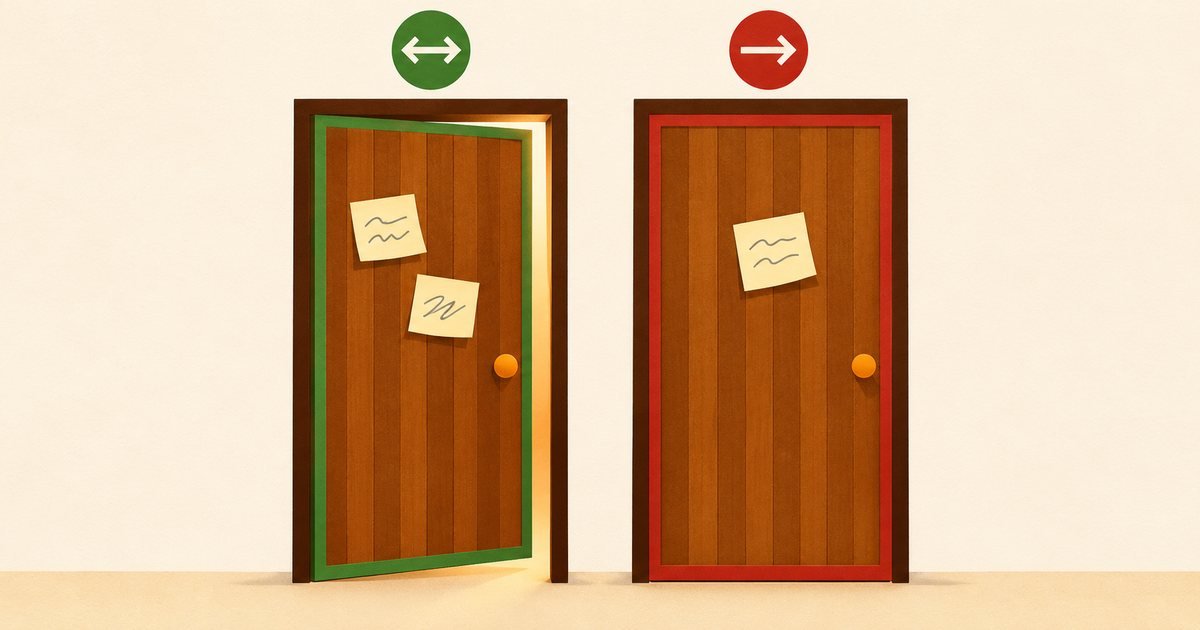
One-way door vs two-way door: how to tell them apart
Decisions rarely arrive with a label. Ask these four questions before you pick a door.
- What does it cost to undo? Count the money, the hours and the goodwill. If undoing it costs little, you’re looking at a two-way door.
- Who feels it if you get it wrong? A change to your own team’s routine is easy to reverse. A change that touches customers, jobs or contracts usually isn’t.
- How long until you can go back? A tool trial ends the day you say so. A three-year supplier contract keeps you there for three years.
- Can you test a small piece first? If you can try it with one team, in one region or for one month, you have turned a one-way door into a two-way door.
If the answers point both ways, treat it as a one-way door for now, and look for the small test that turns it into a two-way door decision.
Two-way door decision examples (and their one-way cousins)
The same kind of choice can sit behind either door. What matters is how easily you can walk back.
Two-way doors: changing the agenda template for your weekly meeting, trying a new project tool for one month, moving the team meeting from Monday to Tuesday, changing the layout of a monthly report, or letting one team swap the daily stand-up for written updates for a month.
One-way doors: closing the office in Lisbon, signing a three-year contract with a new supplier, making a role redundant, or moving your data to a platform that won’t let you export it later.
Look at the pairs. A one-month tool trial is a two-way door decision, but a three-year licence for the same tool is a one-way door decision. The tool is identical, and the door depends on what it costs you to leave.
Why teams treat every two-way door decision like a one-way door
Bezos saw this trap at Amazon back in 2015. As organisations get larger, he wrote, they tend to use the heavy Type 1 process “on most decisions, including many Type 2 decisions.” He listed what follows: “slowness, unthoughtful risk aversion, failure to experiment sufficiently, and consequently diminished invention.”
You have probably sat in that meeting. A small change to a template, or a trial of a new tool, goes to a steering group, then to a second review, then back for more data. By the time it comes back approved, the team has spent more hours talking about the change than it would ever cost to undo.
The fix is a habit: name the door before the discussion starts. You make a two-way door decision in the meeting where someone raises it. A one-way door gets an owner, a deadline and the people it affects in the room.
If you want to see what slow decisions cost your own team in money, the Decision Cost Calculator puts a number on it.
How much information does a two-way door decision need?
Less than you think. In his 2016 letter, Bezos wrote that “most decisions should probably be made with somewhere around 70% of the information you wish you had. If you wait for 90%, in most cases, you’re probably being slow.”
I have followed a close cousin of this rule for years: Colin Powell’s 40/70 rule. Collect 40 to 70 percent of the facts, then use your experience and instinct to decide. Both rules point the same way, and for a two-way door the case is even stronger, because a wrong call is cheap to fix. Bezos put it plainly: “being wrong may be less costly than you think, whereas being slow is going to be expensive for sure.”
How to play the two-way door decision game
Here is how the game at the top of this page works.
- Read the decision on the note.
- Pick its door. Tap Two-way or One-way, or drag the note onto a door.
- Read the speech bubble. It tells you if you were right, why the decision looks like the other door, and where it belongs.
There are ten decisions, and each one looks like it belongs on the other door. That gap is where teams lose time: they treat a two-way door decision like a one-way door, or they rush through a one-way door. Back to the doors
Questions about one-way and two-way doors
What is a two-way door decision?
A decision you can reverse at a low cost. If you don’t like the result, you go back to how things were. Make these calls fast, on your own or with a small group.
What is a one-way door decision?
A decision you can’t take back, or only at a high cost. Bezos called these Type 1 decisions. They deserve time, care, advice from the people affected and one clear owner.
What is the difference between a one-way door and a two-way door?
Reversibility. You can walk back through a two-way door if the result disappoints you, but a one-way door closes behind you. That difference decides how much time, data and sign-off the decision deserves.
Where does the idea come from?
From Jeff Bezos’s 2015 letter to Amazon shareholders, published in April 2016. He came back to it in his 2016 letter.
What are Type 1 and Type 2 decisions?
Bezos’s other names for the two doors. Type 1 decisions are one-way doors: consequential and irreversible, or nearly irreversible. Type 2 decisions are two-way doors: changeable and reversible.
How much information do I need for a two-way door decision?
Less than you think. In his 2016 letter Bezos suggested deciding with about 70% of the information you wish you had.
Can I turn a one-way door into a two-way door?
Often, yes, with a small test first. Try the new supplier in one region before you sign for all of them.
Who should make two-way door decisions?
The person or small team closest to the work. Bezos wrote that “high judgment individuals or small groups” should make them quickly. Sending them up the chain adds days and rarely adds better judgment.
Want to know what a slow decision costs your team?
Put a number on the hours your team spends waiting for decisions.
Try the free Decision Cost CalculatorBuilt by Santiago Tacoronte, 20 years in data and analytics leadership at Virgin, flydubai, Philip Morris and Mondelez. Decision making is one of the sixteen elements of his 4 Productivity Vectors. More free tools in the resources library.