
Let Go Exercise: let go of the thought and move on.
This let go exercise helps you type the thought that keeps coming back, watch it disappear, and get back to work. Nothing is saved or sent.
Nothing you write is stored
Want more free tools like this?
One practical email a week.
The physical ritual
Prefer the real let go exercise board?
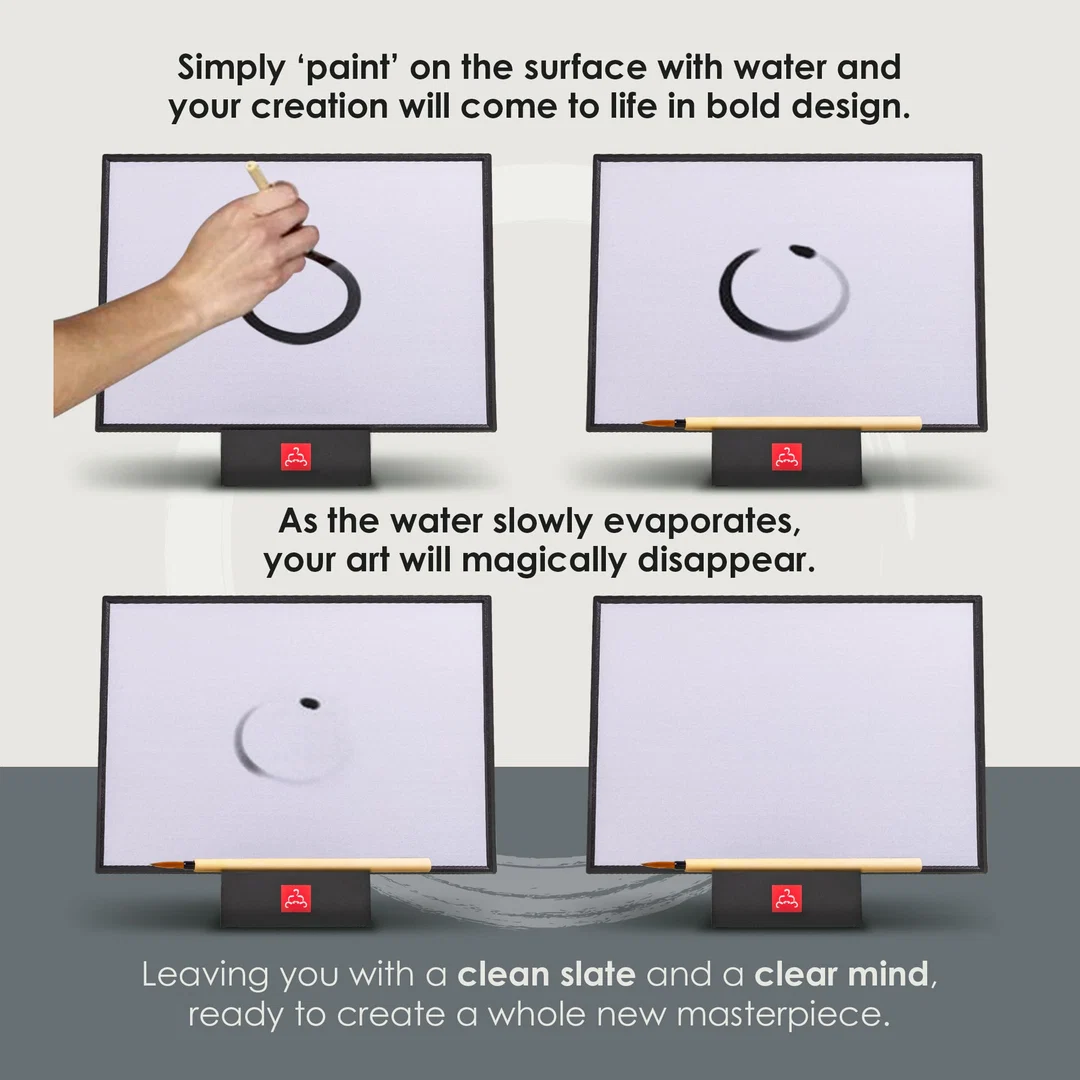
A Buddha board is paper that remembers nothing. You paint with water. The stroke looks like ink and dries in minutes. No screen, no keyboard. You write something down and watch it go. Keep one on your desk if you want a physical version of this let go exercise.
The two boards work for different moments. The digital board is fast, good between meetings. The paper board is slow, good at the end of the day. Many people keep both, then return to the full library of productivity tools for other focus exercises.
Affiliate link. If you buy through it, this site earns a commission at no extra cost to you.
Why this exists
Why the let go exercise builds decision skill
Perfectionism and overthinking are decision-making habits. In the 4 Productivity Vectors, Decision Making sits in the Effectiveness vector. Its most common failure is delay. You rewrite the email. You recheck the numbers. You wait one more day. The work is later. It is not better.
This let go exercise teaches a different habit: decide, act, let go. Write the thought. Watch it disappear. Notice that nothing bad happened. Do this often and perfectionism gets weaker. Letting go means trusting the decision you already made.
Open decisions distract you. When a decision is not finished, part of your attention stays with it. Finish it and the attention comes back. The board helps you finish it, which is why this let go exercise works so well before deep work.
23 min
to resume an interrupted task (Mark, 2005)
11 min
average time on one task before switching (Mark, 2005)
1
decision per visit. Write it, let it go, leave
Sources: Mark et al., “No Task Left Behind?” CHI 2005 (UC Irvine).
This is also where the 4 Productivity Vectors framework fits. Decision Making is one of four elements in the Effectiveness vector, alongside Goal Setting, Prioritisation, and Communication. When it works, the other three speed up too. Decisions close, priorities hold, and goals move. When it stalls, everything downstream stalls with it. The board works on that element directly: one thought, one release, one closed loop.
How to use it
Let go exercise steps: three moves, under a minute
01
Name it
Type the exact thought. The sentence that keeps repeating. The decision you keep postponing. Use plain words.
02
Release it
Stop typing. Watch the words fade. Do not edit. Do not reread. It is fine if the sentence disappears halfway.
03
Return to the work
Go back to work. The board holds nothing, so there is nothing to recheck.
Use it when
You rewrote the same email three times. You reopened a decision you already made. You keep preparing for a conversation instead of having it. You keep polishing work nobody asked you to polish. Use the let go exercise when you need to close the loop and move.
A clear line
Letting go is not caring less
What overthinking looks like
Rewriting the same paragraph five times. Reopening the decision every morning. Asking one more person for an opinion you already have. Acting as if every choice cannot be changed.
What letting go looks like
Deciding with the information you have. Shipping the work and standing behind it. Naming the fear, then moving on. Caring about the result without replaying it forever.
The difference shows in the work. Overthinking delays everything and improves little. Letting go ships work on time. The board builds that habit in under a minute a day.
Questions
Let go exercise questions
- Is my text stored anywhere?
- No. The board runs entirely in your browser. Nothing is saved, sent, or logged. Close the tab and it is gone.
- Does this replace thinking through decisions?
- No. It stops the replay after the decision. Think once. Decide. Then use the board to let the thought go.
- Why does it fade so fast?
- The speed is the point. Long enough to write the thought. Short enough that editing it is pointless.
- Is this therapy?
- No. It is a focus tool for work. If a thought keeps coming back no matter how often you let it go, talk to a professional. The board is for work thoughts only.
- What is a zen board?
- A zen board is a writing surface where the ink fades in minutes. The physical version uses water on special paper. This digital version does the same with text. Write the thought, then let it go.
- Is letting go the same as giving up?
- No. Giving up means you stop trying. Letting go means you stop replaying. You still do the work, make the decision, and have the conversation.
- How often should I use it?
- Whenever a thought keeps repeating. Most people use it a few times a week, before deep work or after a decision. One thought per visit is enough.
One thought. One release.
The board is open. Type the thought. Watch it go.
Free · No email · Nothing stored