

What if the final mile of true success is not about doing more, but about doing what matters most?
I sat with that question for a while after my conversation with Nell Derick Debevoise Dewey on the ProductiviTree Podcast. Nell, known as Nell3D, is a keynote speaker, Forbes contributor, and creator of the Lead in 3D framework. She works with leaders who have checked every box, built a career, grown the team, and managed their life. And yet, something still feels off.
That gap between achievement and fulfillment is precisely where Nell’s work begins. And for those of us obsessed with productivity, her insights offer a powerful recalibration. Because success that feels good requires a fundamentally different approach than success that just looks good on paper.
Who Is Nell3D and Why Should You Care?
Nell3D is a subtraction strategist with credentials that would make most overachievers jealous. Harvard. Columbia Business School. Cambridge. Four continents of humanitarian fieldwork. A decade on the frontlines of global development before she pivoted into executive coaching and leadership advisory.
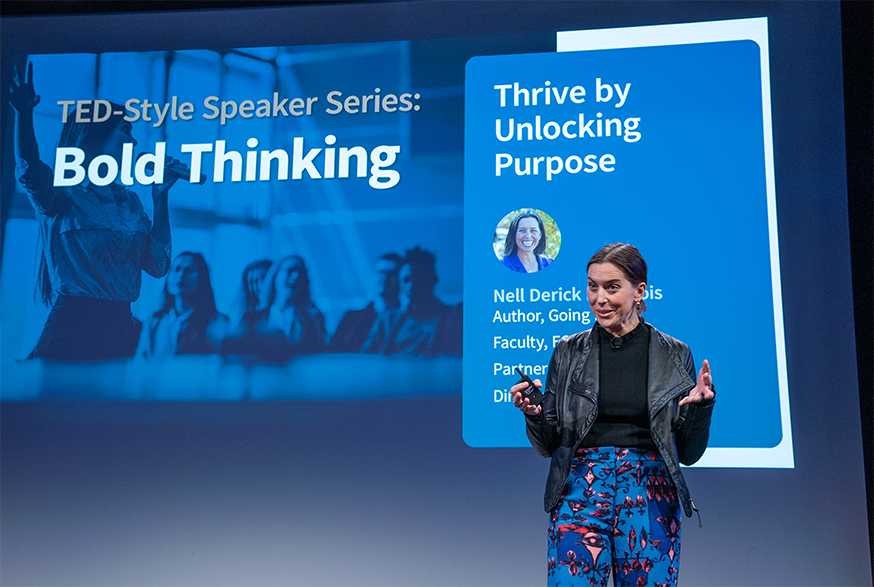
But what makes Nell different from the usual parade of leadership gurus is her origin story. She did not stumble into leadership consulting after a comfortable corporate climb. She chased purpose first, spending ten years doing the real, gritty work of international development. She saw what service looks like when it inspires people, and she saw what it looks like when it drains them dry.
That paradox became the foundation for everything she does now. Nell does not work with leaders in crisis. She works with leaders who, by every external metric, should feel on top of the world. They have the title, the team, the results. And yet, something is missing.
If you have ever finished a massive project, earned a promotion, or hit a revenue target and then wondered, “Is this it?”, Nell’s work speaks directly to you. The question she helps you answer is not “how do I do more?” but “how do I find success that feels good, not just one that impresses other people?”
For leaders who struggle with operational inefficiency or feel like they are running on a treadmill of meetings and admin tasks, this reframe is not fluffy self-help. It is a strategic shift that actually drives better results.
The Lead in 3D Framework: Me, We, World
At the core of Nell’s method is the Lead in 3D framework, a practical system for aligning how leaders invest their time, energy, and attention across three interconnected dimensions.
ME is about personal well-being. Not in the bubble-bath-and-candles sense, but the real kind: sleep, boundaries, self-awareness, and the ability to show up fully without running on fumes. Most high performers neglect this dimension first. They tell themselves they will rest after the launch, after the quarter, after the next milestone. That rest never comes.
WE is about team performance and connection. This is where leadership gets relational. How are you building trust? How are you distributing ownership? Are your people growing, or are they just producing? This connects deeply with something I explore in my own work on the 4 Vectors of Productivity. True productivity is not about squeezing more output from your team. It is about creating the conditions where people do their best work because they want to, not because they have to.
WORLD covers meaningful impact and legacy. This dimension asks: what is the broader contribution of your work? When you zoom out from the daily tasks, the quarterly targets, and the year-end reviews, what are you actually building? And does it matter to you, genuinely?
The beauty of the Lead in 3D framework is that these three dimensions are not competing priorities. They are a system. When you invest in your own wellbeing, you show up better for your team. When your team thrives, your organization creates more meaningful impact. And when your work feels connected to something larger, your personal fulfillment goes up.
This is what Nell means by success that feels good. It is not about choosing between performance and wellbeing. It is about designing a life where both can coexist.
Stop, Drop, and Roll: A Subtraction Strategy for Leaders
Nell’s signature method for putting Lead in 3D into practice is called Stop, Drop, and Roll. It is a three-step process rooted in research, lived experience, and what she describes as “ancient wisdom.” The name is deliberately playful, a nod to the fires it has helped her and hundreds of clients put out.
Stop: Gather Real Data
The first step is to pause. Not in the “take a sabbatical” sense, but in the “actually look at what is happening” sense. Most leaders operate on autopilot. They have inherited habits, inherited schedules, inherited definitions of success that they have never examined.
Stop means getting quiet enough to gather real data about your effort and your impact. Where is your time going? What is actually working? What feels heavy not because it is hard, but because it is not aligned?
This is not unlike what I advocate when I talk about how to plan the week. Before you can plan effectively, you need honest data about where your time disappears. Most people are shocked when they see the gap between where they think their time goes and where it actually goes.
Drop: Release What No Longer Serves You
The second step is subtraction. Nell calls herself a “subtraction strategist” for a reason. Drop means letting go of outdated habits, inherited expectations, and unhelpful assumptions that keep you misaligned.
This could be a recurring meeting that produces nothing. A project you took on to please someone three promotions ago. A belief that you must be the one to review every document, answer every email, or attend every status update.
For knowledge workers and leaders, the inability to subtract is one of the biggest productivity killers. It is also one of the themes I hear constantly from high performers who feel stuck. They know something needs to change, but they keep adding instead of removing. The reasons high performers leave are often connected to this problem: they are doing too much of the wrong work and not enough of the work that gives them energy.
Roll: Connect the Dots
The third step is where Nell’s systems-thinking background shines. Roll means finding the structural opportunities where a single action moves more than one dimension of your life forward.
Instead of treating personal health, team leadership, and community impact as separate buckets that compete for your time, you look for what Nell calls “win-win-wins.” A morning walk that clears your mind (ME), a coaching conversation that develops your direct report’s skills (WE), and a volunteer board meeting where you apply your expertise to a cause you care about (WORLD). These are not three separate items on a to-do list. They are connected investments in a life that works.
Equine-Assisted Learning: Why Horses Make Better Leadership Coaches
One of the most fascinating parts of my conversation with Nell was her work with equine-assisted learning. Nell runs immersive retreats at Rising Circle Ranch in Santa Fe, New Mexico, where leaders work with horses as part of their development journey.
Before you dismiss this as some kind of new-age luxury retreat, consider the mechanics. Horses are prey animals. Their survival depends on reading the emotional states and intentions of the creatures around them. They do not care about your title, your resume, or your PowerPoint skills. They respond to your presence, your energy, and the congruence between what you say and what you actually feel.
For leaders who have spent years perfecting a professional mask, this is deeply revealing. A horse will physically back away from someone who approaches with suppressed anxiety while projecting confidence. It will move toward someone who is calm, clear, and genuine.
According to research published by PATH International, equine-assisted learning promotes the development of life skills for educational, professional, and personal goals. The method is gaining traction in corporate leadership development because it bypasses the intellectual defenses that leaders have spent their careers building.
Nell uses this method to help leaders access what she calls “intuitive insight and authentic leadership presence.” In practical terms, it helps leaders notice the gap between how they perform and who they actually are. And closing that gap is often the first step toward finding success that feels good.
How This Connects to the 4 Vectors of Productivity
Listening to Nell talk about Lead in 3D, I kept finding intersections with the 4 Vectors Productivity framework that I use in my own work. The four vectors are Efficiency, Effectiveness, Ownership, and Wellbeing.
Nell’s ME dimension maps directly to the Wellbeing vector. Both frameworks recognize that a burned-out leader produces diminishing returns. You cannot sustain high performance without investing in recovery, boundaries, and self-awareness.
Her WE dimension connects to the Ownership vector. When leaders build genuine ownership within their teams, when people feel trusted and empowered, the entire system performs better. This is not delegation as a time-management hack. It is a delegation as a leadership philosophy. It is what separates leaders without a title from those who rely solely on positional authority.
And her focus on subtraction aligns with Efficiency and Effectiveness. The leaders who produce the most meaningful results are not the ones who work the longest hours. They are the ones who ruthlessly eliminate waste, break down silos, and focus their energy on the work that creates the highest leverage.
The overlap between Nell’s approach and the 4 Vectors gives me confidence that we are looking at the same truth from different angles. Productivity is not about output. It is about alignment.
What “Do Less, Matter More” Actually Looks Like in Practice
Nell’s mantra is “do less, matter more.” It is a beautiful phrase, but what does it look like on a Tuesday afternoon when your inbox has 47 unread messages and your calendar is stacked with back-to-back meetings?
Here are some practical applications I took away from our conversation.
Audit your calendar against Lead in 3D. Take your weekly schedule and label each commitment as ME, WE, or WORLD. If one dimension dominates and the others are starving, that imbalance is data. It tells you where your energy is leaking and where your fulfillment gap lives.
Apply the Drop test to recurring commitments. For each recurring meeting, project, or responsibility, ask: “If this did not exist, would I create it today?” If the answer is no, that is a subtraction candidate.
Look for win-win-wins. Instead of thinking about work-life balance as a tug of war, look for activities that serve more than one dimension. A lunch conversation with a mentee (WE) that also energizes you (ME) and contributes to developing the next generation in your industry (WORLD) is worth ten times more than another status update meeting.
Use the Stop step before every planning cycle. Before you plan next quarter or next year, stop and gather real data. Not just financial data or KPIs, but human data. How are you feeling? How is your team feeling? What has changed since you last looked honestly at the system?
These are not revolutionary tactics in isolation. But framed within the Lead in 3D structure, they become a coherent strategy for building success that feels good.
The Lesson Most Leaders Miss
The biggest insight from my conversation with Nell is one that most productivity advice completely ignores. Success is not a fixed destination. The metrics that defined success for you five years ago may be actively working against your fulfillment today.
Nell works with leaders who have achieved everything they set out to achieve, and yet they feel emptier than when they started. Not because they are ungrateful. Not because they lack perspective. But because their system of success was designed for a version of themselves that no longer exists.
This is what happens when you optimize for output without ever stopping to ask whether the outputs still matter.
Nell’s Lead in 3D framework gives leaders the vocabulary and structure to recalibrate. To stop treating their career as an escalator that only goes up and start treating it as a landscape they can design intentionally. It is not about slowing down. It is about redirecting your speed toward what actually matters to you, your team, and the world you want to influence.
And that is the kind of success that feels as good as it looks.

Key Takeaways: Finding Success That Feels Good
Nell3D’s work is a powerful reminder that the most successful leaders are not the ones doing the most. They are the ones doing the right things, in the right way, for the right reasons.
The Lead in 3D framework (ME, WE, WORLD) provides a system for aligning your energy around what matters most. The Stop, Drop, Roll method gives you a repeatable process for subtracting what no longer serves you. And equine-assisted learning offers a strikingly honest mirror for leaders ready to close the gap between their performance and their presence.
If you want to explore how aligned your own productivity system is, take the free 4 Vectors Productivity Assessment. It takes five minutes and gives you a clear picture of where meetings, email, and workflows might be pulling you away from the work that matters.
For more conversations like this one, subscribe to the ProductiviTree Podcast on Spotify, Apple Podcasts, or YouTube.
And if you want to learn more about Nell’s work, visit nell3d.com or follow her on LinkedIn. Her Substack, Subtract to Succeed, is also worth your time.